Picture a commuter’s tote at month fourteen. The corners still hold their shape and the zipper still runs. But the handle crease has gone pale, and a hairline crack has opened where the strap meets the body. That bag carried a laptop, a lunch, and a rain shell every working day. Nothing dramatic happened to it. Daily carry is simply the toughest test a PU leather bag ever takes. The failure map it produces repeats so consistently that you can design against it. I handle warranty returns and daily-use feedback for a living. It covers where PU bags fail first, which design choices buy years, and what honest lifespans look like.
Where a PU Leather Bag Fails First in Daily Carry
Open any box of returned bags and the same four zones show up. Handles crease and pale first, because they flex hundreds of times a week and absorb skin oils. Strap anchors come next, where load concentrates on a few square centimeters of coating. Corners scuff through their edge paint, then the backing peeks through. Flap fold lines crack last, right across the grain. PU leather bag peeling almost never starts on the flat panel everyone judges in a product photo. It starts where the bag bends.
The warranty returns I open each month repeat this map across brands and price points. Buyers rarely complain about color or hardware. They complain about the handle that split, the corner that frayed, the edge that went white. Independent durability guides list the same culprits: UV exposure, frequent bending, and moisture working together on the coating.

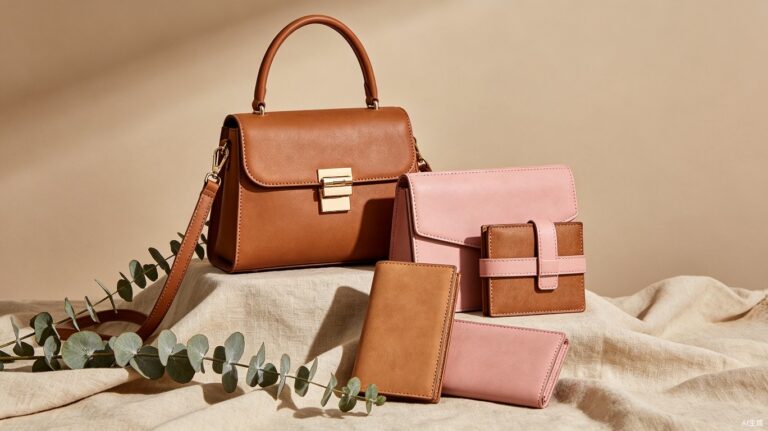
Every fold line in a display like this becomes a handle crease or a flap crack in daily carry.
Design Choices That Buy Years
Here is the part most buying guides skip: at the same material grade, construction decides how fast those zones give up. In our fold-cycle tests, edge-painted and sealed corners survive roughly twice the cycles of raw-cut ones before the coating lifts. Handle anchoring matters just as much. A handle stitched through reinforcement webbing spreads load across a wide patch, while one stitched through a single layer concentrates every pull into a puncture line.
Four spec lines separate a two-season bag from a five-season one. Ask for sealed and painted edges on every panel boundary. Ask for webbing-backed handle anchors. Ask for a lining that carries the load instead of the coating. And ask for the material’s own numbers: abrasion class, color fastness rating, and flex cycles. For programs that need the coating itself to last, hydrolysis-resistant silicone leather removes the failure chemistry entirely.

Rub cycles on a fastness tester predict whether that pale handle crease shows up in month six or year four.
How Long Does a PU Leather Bag Last
The honest answer is a range, and the range tracks the grade you buy. Industry lifespan guides put everyday PU at 2 to 5 years, with low-grade stock peeling sooner and microfiber-reinforced grades pushing past five. Market data on women’s handbags, a $55.8 billion category heading toward $87.1 billion by 2033, still lists genuine leather at 10 to 15 years against 1 to 3 for standard PU. Wholesale pricing follows the same ladder.
| Material Tier | Typical Wholesale | Realistic Lifespan | First Failure |
|---|---|---|---|
| Entry PU | $5-15 per unit | 1-2 years | Handle fold peel |
| Mid-grade PU | ~$20 per unit | 2-5 years | Corner edge cracks |
| Microfiber-reinforced PU | Premium tier | 5+ years | Edge wear |
| Silicone-coated vegan | Premium tier | 10-15 years | None from hydrolysis |
Care stretches the range rather than changing it. Wipe handles down, keep the bag out of hot cars, and avoid overstuffing, which stresses seams and fold lines. But no care routine restores plasticizer that has already left the coating. The chemistry, not the owner, sets the ceiling. If that ceiling is the real problem, our silicone leather introduction explains the polymer that has no plasticizer to lose.
Microfiber-reinforced silicone bag leather in motion: the flex behavior your carry test will never break down.

Bespoke programs get to specify the stress points; stock programs inherit them.
The Carry Test That Matters
Fourteen months of real commutes is the test your customers run anyway, and the design spec sheet predicts its verdict long before the handles go pale. Fashion and accessory brands that spec the stress points first ship the fashion and sports bag programs that never come back. Spec the flat panel and you ship the photo shoot. Spec the handle, the corners, and the fold lines, and you ship the bag people keep.
Request Vegan Bag Material Samples
Is a PU leather bag actually waterproof?
The coating sheds light rain and spills well, which is why PU bags wipe clean so easily. Water finds its way in at stitching holes and unpainted edges, though. Repeated soak cycles then attack the coating from the backing side. Water resistance is real; waterproofing is a construction claim, not a material one.
Does PU leather yellow or smell over time?
Light-colored PU can yellow as the polymer oxidizes, and budget grades carry a chemical smell until it off-gasses. Both signals point to the same root: coating quality. Higher-grade PU and silicone-based coatings hold their shade and ship essentially odor-free, which is worth one spec line in your purchase order.
References
- 1. https://seller.alibaba.com/blogs/2026/southeast… — Women’s handbag market $55.8B in 2026 to $87.1B by 2033; genuine leather 10-15 year lifespan vs PU 1-3 years
- 2. https://szoneierleather.com/how-long-pu-leather… — PU leather lasts 2-5 years; microfiber-reinforced grades exceed 5 years; flaking signals polymer oxidation or UV damage
- 3. https://www.microfiberfauxleather.com/pu-leathe… — PU bags crack over time where genuine leather ages; overstuffing accelerates coating failure