
Special Functional Fabrics
Engineered leather surfaces for extreme environments — where a standard material is not enough.
Series 01: Solar Reflective Leather — dark in color, cool in the sun.
Every fabric on this page is tied to a verifiable test standard — engineering, not marketing.
One Page, Every Special Fabric We Develop
Special Fabrics is TOPSUN’s topic hub for functional leather that goes beyond conventional collections. Each fabric solves a specific environmental problem — and is published only when it can be verified by a recognized test standard.
Standard-Verified
Every fabric is linked to a national or international standard with published thresholds — like GB/T 39370-2020 for solar reflectance. Claims come with test reports.
Application-Driven
Each material starts from a real field problem — overheated car cabins, sun-exposed marine decks, scorching outdoor furniture — not from a lab curiosity.
Continuously Extended
As new special fabrics pass verification, they join this same page as a new numbered series — bookmark it and watch it grow.
Solar Reflective Leather
Dark in color. Cool in the sun. — looks like any deep-black leather, yet reflects the near-infrared band where most solar heat is carried.
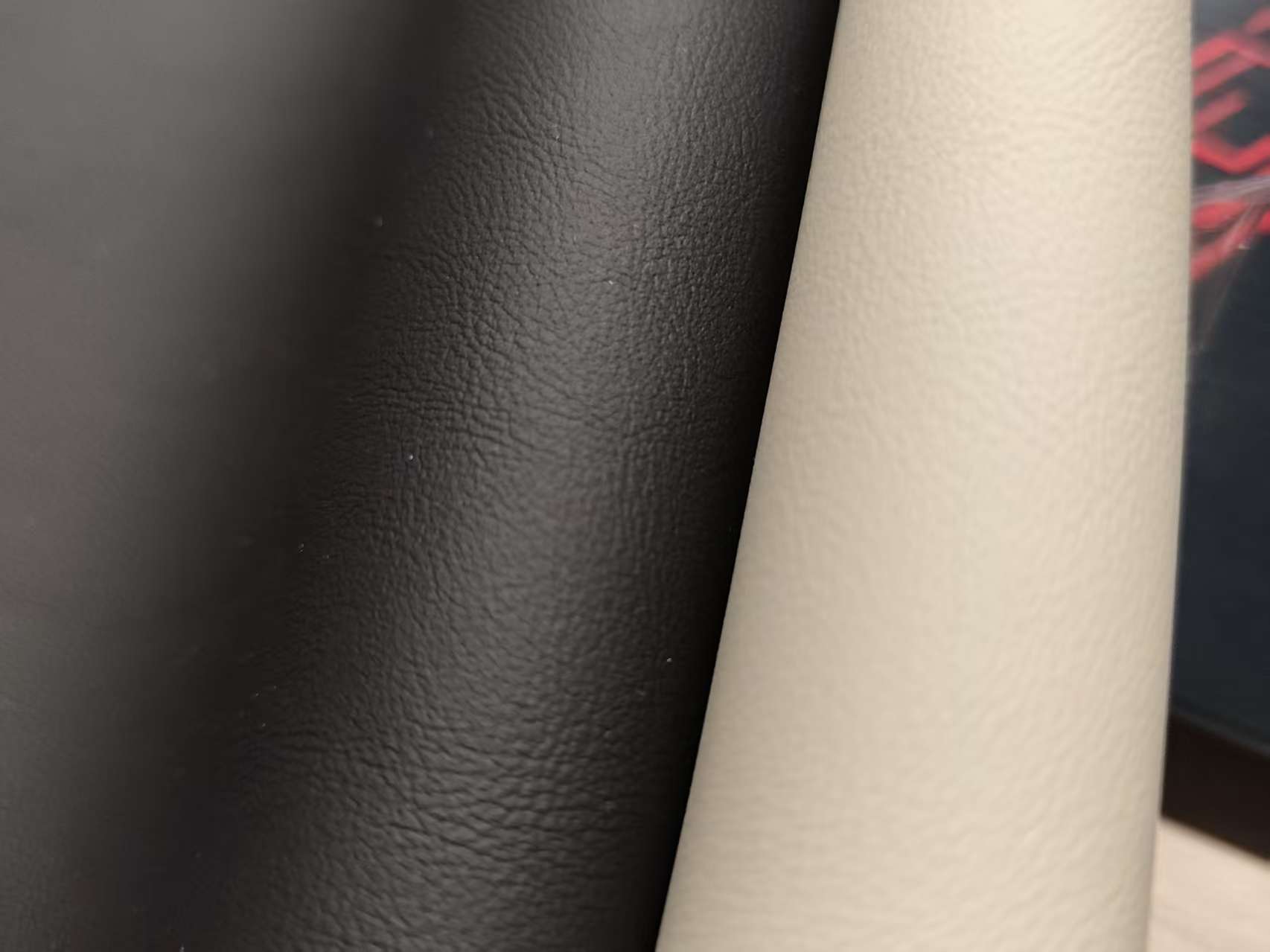
The Same Deep Color, Without the Heat
Solar reflective leather uses NIR-selective pigments in the coating layer instead of conventional carbon-black colorants. Visible light is absorbed normally — so the surface stays black, deep grey or deep brown — while the near-infrared band (780–1100 nm), which carries most solar heat, is strongly reflected away. TOPSUN applies this technology on its silicone leather base, keeping full weathering and temperature resistance.
- Reflects ≥ 55% at 900nm — the classification threshold of GB/T 39370-2020
- Same deep colors, far lower surface temperature under direct sun
- Silicone base performance fully preserved — hand feel, abrasion, hydrolysis and weathering resistance
- Coating-level technology — also applicable to PU and genuine leather substrates on request
Selective Infrared Reflection — Dark Look, Cool Touch
Conventional dark colorants (carbon black) absorb both visible light and near-infrared, so dark surfaces heat up fast in the sun. The NIR-selective coating absorbs only the visible band to keep the deep color, and reflects the heat-bearing NIR band back out — the same color, dramatically less heat absorbed.
Four Advantages of Solar Reflective Leather
Heat control without sacrificing color, feel or durability
Cooler Surfaces
Significantly lower heat build-up than conventional dark leather under identical sun exposure — seats, armrests and surfaces stay touchable.
True Dark Colors
Black, deep grey and deep brown without the heat penalty. No need to compromise your design language with pale colorways.
Base Performance Kept
Hand feel, Martindale abrasion, hydrolysis resistance and the silicone base’s -40°C to 250°C tolerance are fully preserved.
Outdoor-Grade Aging
UV and weathering resistant coating system, engineered for long-term outdoor exposure — the harder the environment, the bigger the gap vs. ordinary material.
Solar Reflective Leather Technical Data
Optical performance verified per GB/T 39370-2020 · supply parameters match the TOPSUN silicone base
Optical & Thermal Performance
Measured with a UV-VIS-NIR spectrophotometer and integrating sphere under standard conditions. Full test report with 900nm reflectance, TSR and temperature-rise data is available on request.
Specification & Supply
The NIR function is a coating-layer technology; every other parameter of the silicone base — thickness, texture, color — remains fully customizable to your project.
| Parameter | Value |
|---|---|
| Classification Standard | GB/T 39370-2020 (aligned ISO 17502:2013) |
| Diffuse Reflectance @ 900nm | ≥ 55% (classification threshold) |
| Test Band | 400 – 1100 nm (visible + near-infrared) |
| NIR Reflection Band | 780 – 1100 nm (main solar heat band) |
| Additional Metrics | TSR · temperature-rise comparison |
| Test Method | UV-VIS-NIR spectrophotometer + integrating sphere |
| Parameter | Value |
|---|---|
| Base Material | TOPSUN silicone leather |
| Key Technology | NIR-selective pigment coating layer |
| Colors | Black / deep grey / deep brown · Pantone & RAL matching |
| Thickness Range | 0.8 – 2.0 mm |
| Width | 1350 – 1400 mm (53" – 55") |
| MOQ | 500 meters |
| Lead Time | 7 – 15 days |
| Warranty | 12 months |
Same Sun. Three Different Surfaces.
Why deep colors usually mean hot surfaces — and how solar reflective leather breaks the trade-off
Illustrative comparison. Exact temperature-rise values depend on color and construction — full data is provided in the GB/T 39370-2020 test report supplied with orders.
| Type | Visible Light | Near-Infrared | Heat Build-Up |
|---|---|---|---|
| Conventional dark leather | Absorbed | Strongly absorbed | Very high — hot to touch |
| Solar reflective leather | Absorbed (deep color kept) | Highly reflected | Significantly lower |
| Light-color ordinary leather | Reflected | Reflected | Low — but color choice limited |
Where Solar Reflective Leather Earns Its Keep
Anywhere deep-colored leather meets direct sun — the harder the exposure, the bigger the benefit
Automotive Interiors
Seats, door panels, armrests — cabin thermal management is a real OEM pain point under glass roofs and hot climates.
Yachts & RV
Deck seating, helm covers and interior panels — surfaces behind glass and under open sun stay usable in peak summer.
Outdoor Furniture
Patio, poolside and garden upholstery — deep-colored designs that no longer scorch in afternoon sun.
Bags & Outdoor Gear
Functional packs, cases and specialty equipment fabrics that face hours of direct exposure in the field.
Architectural Soft Furnishing
Sun-exposed wall cladding, shading wraps and contract interiors where surface temperature affects comfort.
Special Fabrics — Common Questions
The technical questions buyers ask most about this series
Bring Us Your Heat Problem
Sun-exposed, deep-colored, and tired of scorched surfaces? Send us your application scenario — our engineering team will match or develop the right special fabric for it.