Every step bends a shoe upper at the forefoot, and a daily-wear pair logs thousands of those bends a month. Laboratory flex data puts the gap between builds in hard numbers. A heavily finished synthetic leather upper starts cracking near 10,000 Bally flex cycles. A high-performance build passes 100,000. On a foot, that difference shows up as smooth panels versus a cracked crease within 8 to 18 months of daily wear. Synthetic leather shoes live or die on this number.
This guide reads a shoe upper the way a lab does. It covers three failure modes, three surface chemistries and one decision tree for matching the build to the job.

What Synthetic Leather Shoes Actually Wear First
Shoe uppers rarely fail everywhere at once. They fail at three predictable points, and each has a matching laboratory test. The table below is the whole inspection in one view. Learn the lab signal, and the on-foot symptom stops being a mystery.
| Failure Mode | Lab Signal | On-Foot Symptom | Build Fix |
|---|---|---|---|
| Crease cracking | Bally cycles to first crack | White crack line at the toe break | Thicker coating, flex-optimized formula |
| Hydrolysis | Humid-aging retention data | Stiff, flaking surface after storage | Hydrolysis-resistant or silicone chemistry |
| Finish peel | Wet flex and rub results | Color film lifting at high-wear zones | Bonded topcoat, batch-linked reports |
The Flex Crease: Where Synthetic Leather Shoes Fail
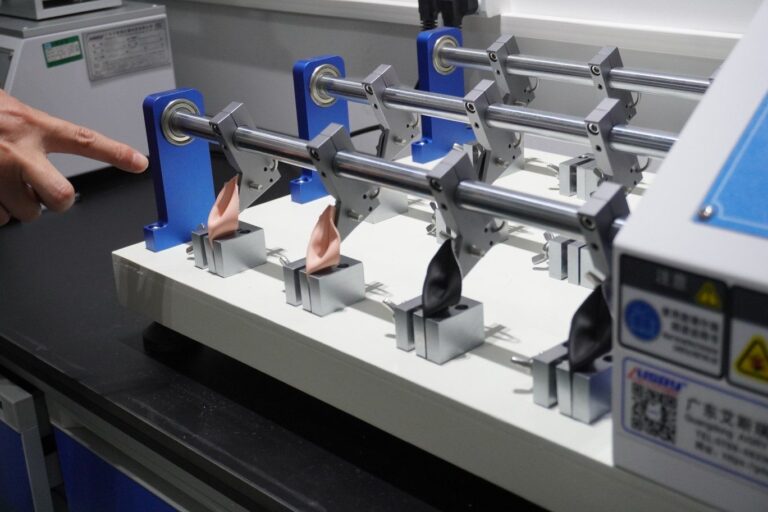
The standard Bally flex test bends the forefoot zone about 22.5 degrees at roughly 100 cycles per minute. The specimen measures 70 by 45 mm. Testers inspect the sample at set intervals and record one number: the cycle count at first visible cracking. That single figure separates the market. A low-performance, heavily finished synthetic upper fails near 10,000 cycles. A high-performance build passes 100,000 dry cycles and keeps going.
Wet testing tells the second half of the story. Rain, sweat and street salt soften coatings, and some materials drop sharply in crack resistance under wet conditions. A pair that survives a dry summer can split at the crease after one wet winter. Buyers who compare dry and wet flex numbers side by side screen out that failure before production. It never reaches the returns dock.
How many cycles does a buyer actually need? Work backward from wear. A daily-wear pair bends its crease roughly 700 times a week. At that rate, 10,000 lab cycles can translate into a season of real use. Doubling the rating does not double the price. It usually costs a few percent per meter and removes the most common warranty claim in the category.

Hydrolysis: The Failure You Cannot See Coming
Crease cracking announces itself. Hydrolysis does not. PU chemistry absorbs moisture over time, and in humid climates the polymer slowly breaks down from the inside. The surface stiffens, flakes and peels, often while the shoe sits in a closet rather than on a foot. This is why a two-year-old pair can look unworn and still fall apart in a week. Brands that source for humid regions now specify hydrolysis-resistant grades. Our hydrolysis-resistant silicone leather page documents how silicone chemistry sidesteps the reaction entirely.
Upper Chemistry: PU, Microfiber and Silicone Compared
Three builds dominate the synthetic upper market. Standard PU coats a knit or woven base: soft hand, lowest cost, weakest against hydrolysis and repeated flexing. In coastal or monsoon markets, buyers increasingly treat hydrolysis data as a gate rather than a nice-to-have. Microfiber builds tighten the base structure, which sharpens surface uniformity and lifts flex endurance a clear tier above entry PU. Silicone coatings sit at the top: no plasticizers to migrate, and stable across temperatures. They hold the strongest wet-flex retention of the three.
Performance testing in practice: flex, abrasion and surface behavior.
One distinction matters when quoting silicone grades. Full-silicone surfaces and semi-silicone laminates behave differently on a shoe. The first maximizes durability and clean-room use cases. The second trades some performance for a lower meter price. Our full versus semi silicone leather guide walks through where each earns its cost. For footwear, the deciding factors are the crease cycle target and the climate the pair will live in.
A Decision Tree for Synthetic Leather Shoes

Match the build to the job with four questions, asked in order. The order matters because durability failures compound; a crease problem on a hydrolyzing film is two claims, not one.
- Daily commuter wear on dry pavement? Demand a Bally dry-flex rating above 50,000 cycles and a woven base, then judge price.
- Humid climate or long warehouse storage? Put hydrolysis data first, and prefer silicone or hydrolysis-resistant PU over standard PU film.
- Rain, snow or salt exposure? Compare wet-flex numbers against dry, and reject any build where the drop is undocumented.
- Occasional seasonal wear at entry price? Standard PU remains rational; just accept the 8 to 18 month crease horizon and size expectations to it.
Run the four questions in order and the chemistry chooses itself. The flex crease always writes the final verdict on synthetic leather shoes. The only decision left to a buyer is whether that verdict arrives in the lab or on the street.
TOPSUN supplies silicone leather to footwear and accessory brands, with batch-linked test reports. Coverage includes flex endurance, hydrolysis resistance and REACH compliance.
Monthly capacity runs at 500,000 meters with a 500-meter MOQ, serving buyers in 30+ countries for eight years.
Match the Build to Your Shoe Program
References
- https://birchbury.com/blogs/article/leather-vs-… — Synthetic uppers fray and peel at the flex crease within 8 to 18 months of daily wear.
- https://www.iso.org/obp/ui/#iso:std:iso:17694:e… — ISO 17694:2016 defines the flex-resistance test method for footwear uppers and linings.
- https://www.gester-ppetesting.com/bally-flexome… — EN ISO 20344 Bally flex method: 22.5 degrees at 100 cycles per minute; synthetic uppers failing near 10,000 cycles versus 100,000 for high-performance builds.