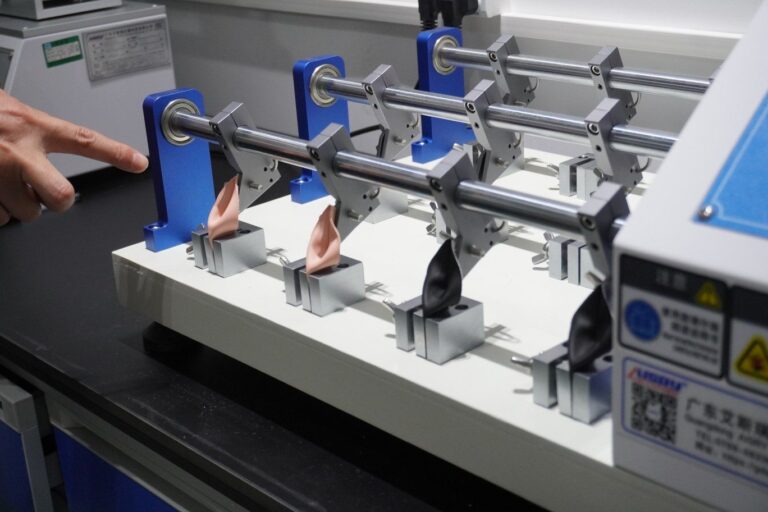
A purchasing manager once showed us one sample card for four different projects. Restaurant booths, car seats, gaming chairs, and salon chairs. Same brown color, same soft hand, same supplier quote. Her question was sharp: why did three quotes from one factory differ by forty percent? The answer is that leather fabric uses are not interchangeable. Each application attacks the material with a different failure mode, and each one needs its own specification line.
I buy coated fabrics for a furniture group with hospitality and automotive clients. This article breaks down four everyday uses and the four specs they demand. It shows the field failure modes and the numbers that belong in your RFQ before you compare prices.
Why Leather Fabric Uses Change the Specification
The same base material can serve many products. The working conditions are never the same. An office chair used eight hours a day lasts two to three years in PU. A dining chair under lighter use lasts three to five. An occasional accent chair stretches to five to seven. Same chemistry, different duty cycle, different life. Buyers who quote one spec across all projects always overpay somewhere. Either the accent chair is over-engineered, or the booth seating fails early.
The abrasion gap between uses is just as wide. Furniture upholstery commonly specifies Martindale resistance from 25,000 cycles. Automotive grade material demands 50,000 cycles or higher, plus light fastness at grade 6 on the ISO 105-B02 scale. Cabin temperatures from minus 20 to plus 80 degrees C add a thermal burden that living rooms never impose. For the chemistry reasons behind these gaps, our silicone versus PU comparison covers the material science.

One card, four projects: the specs behind each swatch are never identical.
Leather Fabric Uses Compared Across Four Applications
Each of the four applications below punishes a different weakness. Restaurants punish porous surfaces with grease and daily disinfection. Cars punish coatings with heat, cold, and VOC limits. Gaming chairs punish coatings with sweat chemistry and long static contact. Salons punish everything with dyes, alcohol sprays, and sharp tools. The table condenses what each use demands and the spec line that wins it.
| Application | What the Use Demands | The Spec Line That Wins |
|---|---|---|
| Restaurant and cafe booths | Grease, food contact, daily alcohol disinfection | Stain level 5; FDA 21 CFR food contact; alcohol-safe |
| Automotive seating | Friction at bolsters, -20 to +80 C cabins, VOC limits | FMVSS 302; -40 to 200 C range; VOC non-detect |
| Gaming and office chairs | Sweat pH, 8-hour daily contact, armrest rub | Martindale 200,000+; hydrolysis life 10-15 years |
| Salon styling chairs | Hair dyes, alcohol sprays, scissor contact | Level 5 stain resistance; tear 20+ N; easy-clean |
Restaurant work is the cleanest example. Industry material guides route commercial seating toward higher-grade construction. Our own furniture and sofa program follows that logic with food-contact documentation attached. Booth seats wiped with alcohol sanitizers ten times a day need a coating that neither swells nor dulls. That is exactly what the stain and chemical numbers measure.

Booth duty: grease, sanitizers, and food contact, every single day.
Matching Leather Fabric Uses to Construction and Certificates
Construction follows the use just as certificates do. Commercial sourcing guides place high-traffic interiors in the 0.7 to 1.3 millimeter band with robust backing. Heavy-duty transit and marine work often moves to PVC at 1.0 to 1.5 millimeters for stiffness. Our silicone lines span 0.23 to 3.0 millimeters across six collections. Thickness follows the application instead of forcing the application to accept a stock roll.
Automotive interior work adds the strictest paperwork. Flame retardance under FMVSS 302 and VOC results under ISO 16000-6 are baseline requirements. Stable performance across the full cabin temperature range is not an extra. Our automotive interiors program documents all three with every order. Salon and care environments weigh hygiene differently. Alcohol-safe disinfection and biocompatibility under ISO 10993 matter more than stiffness. That is why our medical and healthcare line shares its certification pack with salon buyers.

Gaming duty: sweat chemistry meets eight hours of daily contact.
Procurement terms belong in the comparison too. A solvent-free synthetic program in the market typically quotes 1,000 meters per color with 20 to 35 day delivery. Our terms run 500 meters per order with 7 to 15 day delivery and SGS reports attached. That changes pilot economics for product teams testing several uses at once. A shorter loop lets you spec each application properly instead of averaging four projects into one compromise grade.
The four-use checklist compresses to one habit: write the failure mode into the RFQ. Name the disinfectant, the cabin temperature, the sweat exposure, or the dye contact. Then ask each supplier for the test method and the number that answers it. Quotes become comparable the moment the failure modes are explicit.

Salon duty: dyes, sprays, and scissors, a spec all their own.
Material comparison: how silicone construction differs across uses.
One material can serve many products only when the specification flexes with each use. Quote the duty cycle, demand the matching numbers, and the same factory can price all four projects fairly. That is how a buyer turns leather fabric uses from a pricing mystery into a controlled table.
Send Us Your Application Specs for Review
Request Application-Matched Samples with Reports
About TOPSUN
TOPSUN manufactures full-silicone coated fabrics for restaurant seating, automotive interiors, gaming chairs, and salon furniture, serving buyers in 30+ countries with 8+ years of specialized coating experience.
MOQ 500 m, delivery in 7-15 days, SGS reports with every order. Thickness options run from 0.23 to 3.0 mm across six product lines.
Frequently Asked Questions
Can one material grade cover restaurant, automotive, gaming, and salon uses? Rarely. The duty cycles differ too much: food contact, cabin heat, sweat exposure, and dye contact each stress a different property. A shared base construction is possible, but expect thickness, surface treatment, and certificates to vary by application. Price each project against its own spec line.
Which documents should I collect before approving a supplier? Collect the test method and the result for every claim that touches your failure mode: Martindale cycles, hydrolysis chamber hours, VOC value, food-contact letter, and flame-retardant certificate. Third-party reports such as SGS carry more weight than factory self-declarations. Keep the methods on file so reorders can be verified against the same benchmarks.
References
- https://leathermingle.shop/blogs/news/upholster… — Furniture vs automotive specs: Martindale 25,000+ vs 50,000+, ISO 105-B02 grade 6, cabin range -20 to +80 C.
- https://www.cignoleather.com/blogarticle-1/how-… — Commercial durability ratings: 0.7-1.3 mm for high-traffic interiors; PVC 1.0-1.5 mm for transit and marine duty.
- https://de.sihoo.com/en/blogs/kaufberatung/was-… — PU leather lifespan by use: office chair 2-3 years, dining chair 3-5 years, accent chair 5-7 years.