What does the phrase green fabrics actually verify? Two sourcing managers can put the same words on the same quote sheet and mean entirely different things. One means a recycled-content percentage a lab can reproduce. The other means a nice shade of sage and a paragraph about responsibility. Buyers at the 2026 Showtime fair made the difference expensive to ignore. Mills that arrived with exact recycled percentages, water recycling rates, and OEKO-TEX-backed dye claims wrote the orders. The rest explained themselves. This guide separates the claims that hold from the claims that fold.
| Vague Claim | What a Buyer Can Verify Instead |
|---|---|
| “Eco-friendly material” | Named certificate with a report number |
| “Sustainable production” | Facility-level certification such as OEKO-TEX STeP |
| “Safe chemicals” | Tested-for-substances list with limits and results |
| “Low emissions” | VOC test method and non-detect result |
| “Long-lasting, less waste” | Abrasion, flex, and service-life test data |
What Buyers Actually Mean by Green Fabrics Now
The word green has been losing value for years. The 2026-2027 buying season is finishing the job. Industry coverage of the Showtime fair in High Point describes buyers demanding the exact percentage of recycled content, the mill’s water recycling rate, and dye systems that meet OEKO-TEX or Bluesign standards. Some mills now print full lifecycle assessments directly on sample tags. The takeaway from that show floor was blunt. If a sustainability story is not backed by third-party certification by 2027, it loses shelf space to the brands that carry one.
Consumer pressure is the engine behind that shift. Shoppers increasingly scrutinize supply chains, carbon footprints, and material sourcing before they commit to furniture purchases. A green fabric claim that survives that scrutiny has three properties. It is specific, it is tested, and someone else did the testing.

The Certification Stack Behind a Real Green Fabric
OEKO-TEX runs the most recognized modular system in this space, and knowing how the modules fit together turns a confusing alphabet into a checklist. STANDARD 100 remains the benchmark for harmful-substance testing from yarn to finished product. It screens against a list of more than 1,000 substances, reviewed at least annually. LEATHER STANDARD extends that same substance testing to leather articles, from semi-finished material to finished goods.
STeP certifies the production facility itself under sustainable and socially responsible conditions. ECO PASSPORT covers the chemicals, colourants, and auxiliaries that go into the material. MADE IN GREEN ties the whole stack together with traceability down to the production facility.
| Certificate | What It Verifies | Applies To |
|---|---|---|
| STANDARD 100 | 1,000+ harmful substances tested | Textiles, yarn to finished product |
| LEATHER STANDARD | Same substance testing, leather scope | Leather articles and accessories |
| STeP | Sustainable production conditions | Production facilities |
| ECO PASSPORT | Chemicals and dyes verified safe | Chemical suppliers |
| MADE IN GREEN | Substance safety plus traceable chain | Labeled consumer products |
The practical move for a sourcing team is to map each green fabric candidate against this stack before the first sample ships. Materials that enter the conversation with a clear certificate trail, such as silicone leather, move faster for exactly this reason. The certificates already exist. Nobody has to promise anything.
Where Silicone Leather Fits the Green Spec
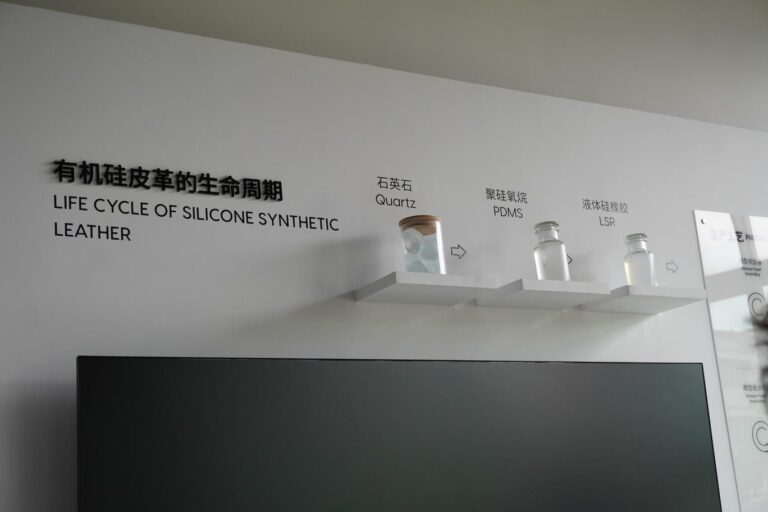
Silicone polymer chemistry supports a green fabric spec in four measurable ways. First, emissions: our material tests non-detect for VOC under ISO 16000-6, which puts a number where a claim would normally sit. Second, composition: no plasticizers, no chlorine, and no solvent-based plasticizer system to migrate into indoor air. Third, compliance: REACH certification, eight regulated PAHs not detected, and ISO 10993-5 cytotoxicity passing at 74.58 percent cell viability, all issued by SGS.
Fourth, longevity: a service life beyond 10 years, roughly three times the span of PU or PVC. It is the least glamorous and most effective green argument there is. A material that gets replaced half as often halves the waste stream attached to it.

Buyers comparing options under an eco-friendly silicone leather program usually start with the VOC and REACH reports, then move to durability data. That order matters. The certificates open the door. The service life closes the argument, because durability converts a green claim into a procurement win on total cost.
The Greenwash Gap: What Fails Under Scrutiny
The claims that fold share a pattern. They use nature words instead of test methods. They cannot survive a request for a report number. Retail onboarding teams in the EU and US increasingly ask for documents during listing, not after, which turns every vague claim into a delayed order. Plant-based novelty materials illustrate the trap. A material can carry an inspiring origin story, like mushroom-based leather alternatives, and still lack the substance testing and durability data a commercial program requires. The story qualifies it for press coverage, not for a purchase order.

For furniture programs, the scrutiny lands on both sides of the ledger. Sustainability opens the conversation, and performance closes it, which is why upholsterers evaluating furniture and sofa applications test abrasion and flex alongside any green certificate. A green fabric that pills in year two creates a different kind of return problem. The order goes to the option that clears both bars.
The Spec That Survives 2027
Green fabrics stopped being a marketing category. They are now a documentation category, defined by certificates that someone else issued and tests that anyone can repeat. Build every material decision on that foundation. When your shortlist shows a named standard, a report number, and durability data next to each entry, the green claim finally means something a buyer can act on. Request Certified Eco Material Samples
What certificate should a green fabric spec require first?
Start with harmful-substance testing such as OEKO-TEX STANDARD 100 or LEATHER STANDARD, then add facility-level STeP certification. Together they cover both the material and the plant that made it.
Is silicone leather accepted as a green fabric?
It supports the documentation-first definition: non-detect VOC under ISO 16000-6, REACH compliance with PAHs not detected, and a 10-plus year service life that reduces replacement waste.
Our team can map your current spec against the full certificate stack in one call. Talk to Our Sustainability Team
References
1. oeko-tex.com: our standards — modular certification system: STANDARD 100, LEATHER STANDARD, STeP, ECO PASSPORT, MADE IN GREEN definitions and scope
2. itma-showtime.com: fabric trends high point — buyer demand for exact recycled percentages, water recycling rates, OEKO-TEX and Bluesign dye standards, 2027 shelf-space risk