When a buyer asks, “Your spec says genuine leather — where does it actually come from?”, most suppliers answer with one word: cowhide. That single word hides three auctions, two continents, and one cattle cycle. Leather comes from a supply chain that spec sheets almost never describe. This article maps the real routes: which animals, which layers of the skin, which countries. For B2B procurement, origin is not a story. It is a risk variable you can price.
| Animal source | Share of global supply | Hide traits | Typical B2B uses |
|---|---|---|---|
| Cattle | ≈ 69% | Heaviest, largest area, full-grain potential | Automotive, upholstery, belts, workwear |
| Sheep | ≈ 13% | Soft drape, fine natural grain | Apparel, gloves, luxury goods |
| Goat | ≈ 11% | Tough for weight, distinct pebbled grain | Footwear, bags, upholstery |
| Pig | ≈ 6% | Abrasion-resistant, visible pore pattern | Furniture, sports goods, workwear |
Why Leather Comes from Beef Plants, Not Leather Farms
Start with the hardest fact to unlearn: almost nobody farms animals for their skins. Around 99% of the world’s hides and skins arrive as by-products of cattle, sheep, goats, and pigs raised for meat and dairy. The leather trade exists to upgrade what the food industry would otherwise discard.
That dependency sets every other rule. Hide supply follows beef demand, not leather demand. WWF market research found that a 1% rise in cattle prices moves hide supply by only 0.1–0.2%. You cannot contract your way to more hides. When herds shrink because beef margins tighten, tannery quotes rise within a quarter.
We have quoted buyers who treated steady hide availability as a given. It is not. Genuine leather is a price-taker material: your purchase order cannot fix what the cattle cycle decides. Keep that in mind before signing any multi-year supply agreement.
The species split also maps to regions. Brazil, the United States, and Australia supply the heavy bovine hides that become upholstery and automotive leather. South Asia and East Africa contribute most of the sheep and goat skins used in footwear and bags. Your raw material’s first address is therefore the beef or lamb industry of a different continent — and its droughts, export bans, and trade deals.

Cattle hides account for roughly 69% of global leather supply — a by-product of the beef and dairy industries.
Where the World’s Leather Comes From: A Production Map
The second half of the answer is geographic. Cattle count does not decide where finished leather is made. Tanning capacity does — and tanning capacity is heavily concentrated.
| Country | Annual tanned output | Dominant categories |
|---|---|---|
| China | ≈ 4.0 billion sq ft | Leads every category: bovine, sheep/goat, heavy |
| Brazil | ≈ 1.7 billion sq ft | Almost entirely bovine |
| Italy | ≈ 1.5 billion sq ft | Bovine plus sheep/goat, strong in fashion |
| Russia / India | ≈ 1.4 billion sq ft each | Russia mostly bovine; India balanced |
| United States | ≈ 6.7 million sq ft | 8th worldwide — despite huge cattle herds |
Read the last row twice. The United States runs some of the world’s largest cattle herds but tans almost nothing: 6.7 million square feet against China’s 4 billion. Much “domestic” American leather is imported and finished abroad.
Three countries control the majority of tanned output. A tariff change, an environmental inspection campaign, or a port strike in one region moves lead times everywhere. That concentration risk never appears on a spec sheet — but it appears on your delivery date.
This is why the Leather Working Group audit system exists. Tanneries receive Gold, Silver, or Compliant ratings based on effluent, energy, and traceability performance. For a buyer, the rating is the closest thing to a verifiable “where” on paper. Ask for it. A supplier who cannot name the tannery and its rating cannot promise consistency between batches — only a story about origin.

Our own material’s lifecycle, from raw inputs to finished rolls — origin as a single address, not a chain of auctions.
Talk to Our Sourcing Engineers
Which Layer of the Skin Actually Becomes Leather?
Neither the hair nor the fat. A hide has three layers. The epidermis is the thin outer skin, removed during liming. The hypodermis is the fatty layer, scraped off at the beam house. What becomes leather is the dermis — a dense collagen network tanners call the corium.
The dermis explains why “cowhide” is an incomplete answer. One hide can be split into two or three layers. The top keeps the grain — the natural pore pattern buyers associate with quality. Lower splits get coated, embossed, or sold under the label “genuine leather.” Same animal. Same country. Very different material.
So when someone asks where leather comes from, the honest follow-up is three questions: which species, which layer, and tanned and finished where. Suppliers who cannot answer all three are reselling, not manufacturing.

The grain layer — the top of the dermis — is the part of the skin that becomes full-grain leather.
Silicone Leather Comes from a Different Chain Entirely
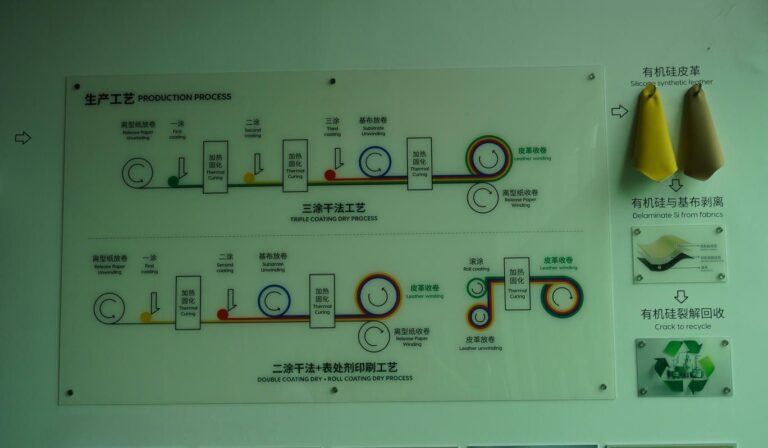
Buyers evaluating our material ask the obvious follow-up: where does silicone leather come from? Not from an animal. The chain starts with quartz. Industrial silica is processed into silicone rubber, which is coated onto a fabric backing and embossed with texture. You can read the full chemistry in our silicone leather introduction.
In our factory, base fabric arrives on rolls, meets the coating line, and leaves as finished sheet goods. No slaughterhouse. No auction. No cattle cycle. The production process runs across three owned bases — Dongguan, Yichang, and Xiangyang — with 6 million meters of annual capacity. Every step sits under one roof, so origin is a fixed point, not a variable.
In our line audits, we time the distance differently than hide buyers do. For us, origin is measured in meters between the siloxane storage tanks and the coating oven — not in shipping lanes between auctions. That single-factory span is what we quote to procurement teams who need a material whose story never changes between POs.
The performance follows from that control. Martindale abrasion beyond 200,000 cycles (ISO 12947-2). Flex resistance past 100,000 cycles (ISO 5402). VOC emissions below detection (ISO 16000-6). Where a material is made decides how consistently it performs — see the specs on our PET-backed silicone leather.

Base fabric on the coating conveyor — the first step of a chain that never touches an abattoir.
Tour the three production bases in two minutes — every meter of our silicone leather starts and finishes inside this network.
About TOPSUN
TOPSUN manufactures organic silicone leather for automotive, furniture, and medical buyers who need one traceable origin instead of an auction-house lottery.
Three owned bases with 6 million meters of yearly capacity, quartz-derived silicone chemistry, ISO-verified performance testing, and OEM color and texture programs.
Map Your Material’s Origin Before You Sign
Practically, the verification is cheap. Require three data points in every hide-leather quote: species, split layer, and tannery name with its Leather Working Group rating. Then cross-check the tannery’s country against current tariff and inspection news. Most sourcing disputes we have seen — wrong grain, inconsistent thickness, missed windows — trace back to one of those three fields being left blank.
So, leather comes from where? The real answer is a chain, not a place: a slaughterhouse, an auction, a shipping lane, a tannery, and a splitting knife. Price each link you cannot see. Work through the branches below before your next material decision.
- If your product lives indoors and the brand story matters → hide leather still wins. But require the tannery name and country on the paperwork.
- If your supply must survive a cattle cycle → ask how your supplier hedges hide volatility, or move the spec off hide entirely.
- If origin traceability is a compliance requirement → a single-factory material gives you the shortest audit path.
- If you sell into the US market → verify the “domestic” claim before you print it. Most American leather is imported and finished abroad.
Request Silicone Leather Roll Samples
Is leather really a by-product, or do farms raise animals for their hides?
A by-product. Around 99% of hides and skins come from animals raised for meat and dairy. The economics run the other way too: leather demand barely moves hide supply. A 1% change in cattle prices shifts hide volumes by only 0.1–0.2%.
Does the country where leather is tanned affect quality?
It affects consistency more than peak quality. Effluent rules, skill pools, and splitting standards differ by region. Two tanneries can turn the same hide into very different products. Ask for the tannery name, not just the country of origin.
Where does silicone leather come from if it is not animal hide?
From quartz-derived silicone rubber coated onto a fabric backing — PET or microfiber. At TOPSUN, every step happens on our own lines across three Chinese factories, which is why batch-to-batch origin never changes.
References
1. https://www.leathernaturally.org/faqs/ — by-product share (~99%) and animal-source split of global hides and skins
2. https://buffalojackson.com/blogs/insight/which-… — country-level tanned leather output (FAO compendium data)
3. https://www.bridgeofweirleather.com/sites/defau… — hide supply price-elasticity finding (0.1–0.2%)