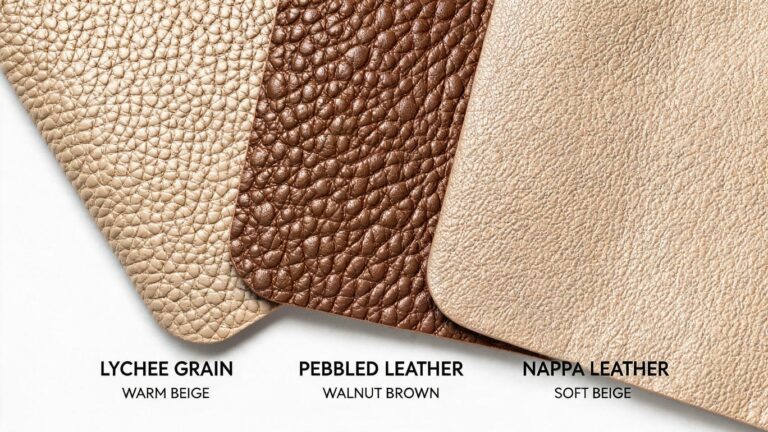
Two sample boxes reach a European furniture buyer in the same week, both tagged eco leather material. Box A holds a mycelium-grown sheet from a materials startup: about €40 a meter, a carbon-footprint PDF tucked in the lid, an 18-week lead time. Box B holds a conventional PU sheet with a small leaf printed on the spec card: $2.10 a meter, in stock, 5,000 meters on the shelf.
The labels match; the polymers, the economics and the environmental evidence do not. That gap is the whole story of this category, and it deserves a market analyst’s read rather than a marketing one.
What “Eco Leather Material” Actually Covers: Four Families, One Label
The term describes a positioning claim, not a polymer class. Behind the label sit four distinct families. Plant-based bio-leathers — pineapple leaf, apple peel, mushroom mycelium — carry the strongest narrative but variable mechanical properties and limited commercial scale. Recycled leather reconstitutes tannery off-cuts into a sheet that is typically 10–30% leather fiber, with a binder doing the structural work.
Next-generation synthetics mean bio-based PU, built on corn- or soy-derived polyols. And the fourth family is conventional PU or PVC that simply ships with greener processing — water-based coatings, reduced solvent load. In our sample audits for European furniture brands, it is usually family four that arrives in the box marked eco. That is why the silicone leather category overview treats “eco” as a question to ask, not an answer to accept.

One label, many shelves: what a buyer receives under “eco” depends entirely on which family the supplier sells.
The $11.6B Market Behind the Eco Leather Material Label
The numbers explain why the label is stretched so thin. Grand View Research values the vegan leather market at $11.6 billion in 2025, rising to $26.8 billion by 2033 at an 11.4% CAGR — and reports that the synthetic segment held 89.4% of 2025 revenue.
Meanwhile PW Consulting sizes the entire bio-based PU leather market at $785 million for 2025, under 7% of the vegan leather total, growing to $1.36 billion by 2032 with corn-based polyols at 39.9% of source types and footwear taking 34.6% of demand. Translation for procurement: the bio-based share is real but small, and most volume sold under a green banner is conventional synthetic. If a supplier cannot name the family behind the label, assume you are paying an eco premium over standard PU.
| Family | Reality Behind the Label | Evidence to Demand |
|---|---|---|
| Plant-based bio-leather | Strong story, variable mechanicals, limited scale | Tensile/abrasion data + bio-content % |
| Recycled leather | 10–30% leather fiber, binder-dependent | GRS certificate + composition sheet |
| Bio-based PU | ~$785M niche, real but under 7% of market | Polyol source disclosure + carbon data |
| Conventional PU/PVC, greener process | The quiet majority of “eco” shipments | VOC (ISO 16000-6) + REACH screening |

What actually ships: volume sits with conventional synthetics, so the family must be named before the price is compared.
Market outlook: where solvent-free silicone materials sit in the category’s growth curve.
Reading an Eco Leather Material Spec Like an Analyst
Three checks turn the label into data. First, make the supplier name the polymer family and the bio-content percentage — “eco” with no noun is not a spec. Second, match each claim to third-party paper: GRS for recycled content, ISO 16000-6 for VOC emissions, REACH SVHC screening for chemical compliance. Third, demand service-life data, because a sheet that hydrolyzes at 85°C/85%RH within weeks is a replacement cycle in disguise, not a sustainability story.
On our own test bench, silicone leather posts QUV 1,500+ hours, Martindale 200,000+ cycles and non-detect VOCs — the eco-friendly silicone leather file documents that evidence line by line.
By chemistry, that Si-O backbone effectively makes silicone a fifth family of its own. Programs that still want a leather-fiber hand can compare the silicone microfiber construction against the four mainstream families before committing to a direction.

The spec to read: family, bio-content %, and the test report that outlives the label.
Eco leather material is not one product — it is four families sharing one label, and 89.4% of the market behind that label ships conventional synthetic. Name the family, file the test report, and the label becomes evidence instead of risk.
Request the Eco Sample Set + Test Reports
References
1. https://www.grandviewresearch.com/industry-anal… — Vegan leather market $11.6B (2025), synthetic segment 89.4% of revenue, 11.4% CAGR to 2033
2. https://pmarketresearch.com/chemi/bio-based-pu-… — Bio-based PU leather market $785M (2025), corn-based polyols 39.9%, footwear 34.6% of demand