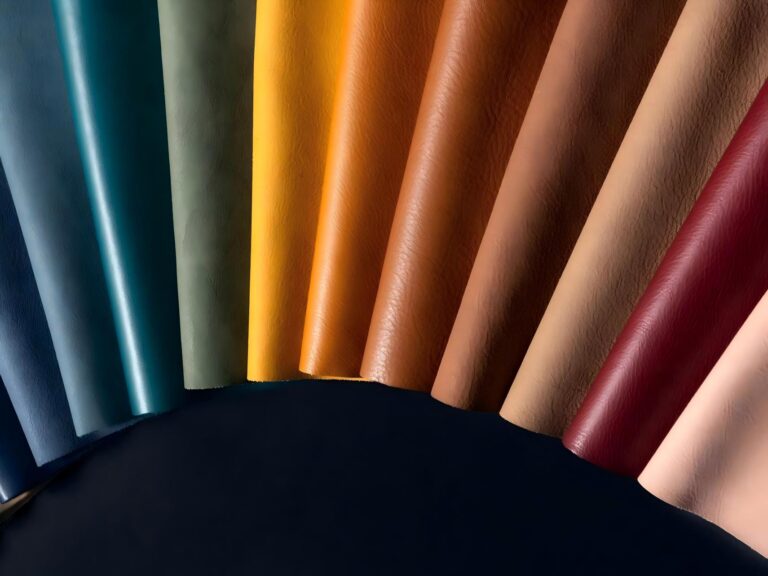
A procurement director at a European furniture manufacturer receives three sample swatches from three suppliers. All three are labeled “ecological leather.” Supplier A sends chrome-free tanned bovine leather certified to Italian UNI 11427. Supplier B sends apple-based bio-leather containing 50% polyurethane. Supplier C sends 100% silicone leather made without solvents. All three claims are technically valid. All three materials are fundamentally different. This is the ecological leather supply chain problem: the term means whatever the supplier wants it to mean, and buyers who don’t verify the definition end up with materials that don’t meet their ESG targets, their compliance audits, or their product performance requirements.
This article maps the three competing definitions, compares their actual environmental metrics, and provides a decision framework for matching the right definition to your supply chain audit requirements.

Base fabric conveyor — the production stage where ecological definitions diverge based on coating chemistry
3 Definitions of Ecological Leather — And Why They Conflict
There is no single internationally recognized definition of “ecological leather.” Three frameworks compete in the global supply chain:
Definition 1 — UNI 11427 (Italian ICEC). The Italian Istituto di Certificazione della qualità per l’industria Conciaria defines “ecological leather” as animal hide tanned with reduced environmental impact — specifically, chrome-free or reduced-chrome tanning, verified water treatment, and compliance with EU chemical regulations. Critically, this definition requires animal raw materials[$TRAE_REF](https://riviste.fupress.net/index.php/fh/article/download/3790/2655/27960), primarily by-products of the food industry. It is leather — just tanned more responsibly. It is not vegan, not plastic-free, and not biodegradable within a meaningful timeframe.
Definition 2 — Plant-Based Bio-Leather. Materials derived from agricultural waste — apple peels, cactus leaves, grape skins, mushroom mycelium. These reduce water usage by 80-90% compared to traditional leather and cut greenhouse gas emissions by 60-85%, according to research cited by the Ellen MacArthur Foundation. However, most plant-based leathers contain 30-50% synthetic binder (typically PU) for structural integrity. They are partially biodegradable — the plant component decomposes in 2-10 years, but the plastic portion persists for 500+ years. No plant-based leather has been tested beyond 3-5 years of field durability.
Definition 3 — Solvent-Free Synthetic. Silicone leather manufactured without solvents, without plasticizers, and without animal-derived inputs. The silicone polymer is derived from silica (sand) — an abundant, non-toxic raw material. Production uses 400-600 L/m² of water, emits 3-5 kg CO2e/m², and generates zero VOC emissions during manufacturing or use. The material lasts 10+ years, reducing replacement-driven waste. It is both vegan and animal-free — satisfying the strictest labeling definitions in both categories.
| Definition | Material Source | Water L/m² | CO2 kg/m² | Toxic Chemicals | Biodegradability | Certification |
|---|---|---|---|---|---|---|
| UNI 11427 Eco-Leather | Animal hide | 14,000-17,000 | 12-18 | Reduced (chrome-free) | 10-50 years | ICEC/UNI 11427 |
| Plant-Based Bio-Leather | Agricultural waste + PU | 200-300 | 18-40 | Low (partial) | Partial (2-10 yr plant) | No standard |
| Silicone Leather | Silica (sand) | 400-600 | 3-5 | Zero (solvent-free) | 10+ yr service life | REACH + ISO 10993 |
Three competing definitions of ecological leather compared by supply chain impact metrics. Data from industry LCA studies and TOPSUN production records.
UNI 11427: The Italian Standard That Requires Animal Hides
The Italian UNI 11427 standard, certified by ICEC, is the most formalized definition of ecological leather in the global market. It requires that the material be genuine animal leather — tanned with reduced chromium or chrome-free methods, processed with verified water treatment, and compliant with EU REACH chemical regulations. The certification track includes audit of tannery effluent, energy consumption, and solid waste management.
For B2B supply chains serving the European market, UNI 11427 certification carries weight — it is recognized by Italian furniture and automotive manufacturers as evidence of environmental compliance. But it does not make the material vegan, plastic-free, or biodegradable. If your product is marketed as “cruelty-free” or “animal-free,” UNI 11427 ecological leather is the wrong material — regardless of how responsibly it was tanned.

Quality and safety compliance banner — the audit documentation that separates certified ecological leather from marketing claims
Plant-Based Ecological Leather: 80% Less Water, Unproven at Scale
Plant-based ecological leathers — cactus (Desserto), apple (Frumat), mycelium, grape — offer the most dramatic water reduction: 80-90% less than traditional animal leather. Cactus leather requires virtually no irrigation. Mycelium grows in days. Apple leather diverts food waste. These are genuine sustainability wins in the raw-material stage.
The supply chain problem is scale and durability. No plant-based leather has been field-tested beyond 3-5 years. None has published Martindale abrasion data above 50,000 cycles. None has achieved production volumes sufficient for high-volume B2B procurement — automotive interiors alone require hundreds of thousands of square meters per model year. For supply chain managers who need material that will be available in consistent volume for 5-7 years of a product cycle, plant-based ecological leather is not yet a viable specification.
Additionally, most plant-based materials contain 30-50% polyurethane binder. A GreenCycle comparison[$TRAE_REF](https://www.greencycle8.com/blog/comparing-eco-friendly-materials-in-leather-goods) notes that while plant-based leathers reduce water and carbon, the plastic content means they still contribute to microplastic pollution — the same end-of-life problem as conventional PU.
Silicone Leather: 400 L/m² Water Use, Zero Toxic Chemicals
Silicone leather occupies the third definition — synthetic, but solvent-free and plastic-free. From our eco-friendly silicone leather production data: water usage of 400-600 L/m² (vs. 14,000-17,000 for animal leather), CO2 emissions of 3-5 kg/m² (vs. 12-18 for animal and 4-6 for PU), and zero solvent use in the coating process. The material passes REACH compliance with no restricted substances above detection limits and ISO 10993-5:2009 biocompatibility certification.
The supply chain advantage is consistency. Silicone leather is manufactured on industrial coating lines — the same equipment used for PU, but with silicone polymer instead of polyurethane. Production volumes scale to meet automotive and furniture OEM requirements. Lead times match conventional synthetic leather. The material is not experimental, not pilot-scale, and not dependent on seasonal agricultural harvests.
For supply chain managers, the critical question is not which definition is “most ecological” — it is which definition satisfies the specific compliance, performance, and volume requirements of the product line being specified. All three definitions have a legitimate claim to “ecological.” None of them satisfy every requirement simultaneously — except silicone leather, which is the only material that is simultaneously vegan, plastic-free, solvent-free, and field-proven at industrial scale.

Industrial calendering equipment — the scale advantage that makes silicone ecological leather viable for high-volume B2B procurement
Supply Chain Decision: Which Ecological Definition Fits Your Audit?
Use this decision framework to match the ecological leather definition to your supply chain audit requirements:
- IF your product is marketed as “genuine leather” and sold in EU markets → UNI 11427 certified ecological leather. Provides formalized environmental compliance for animal leather supply chains. Request ICEC certification number and tannery effluent audit reports.
- IF your product is a niche/luxury item with low volume (under 10,000 units/year) and sustainability storytelling is the primary value proposition → Plant-based ecological leather. Provides the most compelling raw-material narrative. Accept that you are specifying a material with 30-50% plastic content and unproven long-term durability.
- IF your product requires industrial-scale production volume, 10+ year durability, vegan/animal-free labeling, plastic-free composition, and verifiable ESG documentation → Silicone leather. The only ecological leather definition that satisfies all five requirements simultaneously. Request REACH compliance declaration, ISO 10993-5 test report, and Martindale abrasion data (200K+ cycles).
About TOPSUN: TOPSUN supplies silicone leather to B2B supply chains that require verifiable ecological material documentation — with 400-600 L/m² water usage, zero solvent production verified through REACH compliance testing, 3-5 kg CO2e/m² emissions, and ISO 10993-5:2009 biocompatibility certification available for ESG audit packages. Production capacity supports automotive, furniture, medical, and consumer goods procurement at industrial scale. Custom formulations available from 0.23mm to 2.0mm thickness with standard production lead times.
The Bottom Line
“Ecological leather” is not one material — it is three competing definitions with different raw materials, different environmental footprints, and different supply chain implications. UNI 11427 serves traditional leather supply chains seeking reduced environmental impact. Plant-based alternatives serve niche markets with sustainability narratives. Silicone leather serves industrial-scale B2B procurement that needs verified ecological performance data, vegan certification, and 10+ year durability in one material. The right definition depends on your audit requirements — but only one definition satisfies all of them simultaneously.
Video: TOPSUN Silicone Leather Ecological Production Tour — contact us for the factory tour video showing solvent-free coating lines, water usage monitoring, and ESG documentation protocols.