A hydrophobic leather coating starts with impressive numbers. You spray it on, measure a water contact angle of 105°, watch droplets bead and roll off, and sign off on the spec sheet. Twelve months later, a marine upholstery customer reports that those same droplets are now soaking into the leather at stress points — armrest edges, seam allowances, seat bolsters. The contact angle has dropped to 62°. The coating hasn’t failed catastrophically; it has eroded incrementally through abrasion, UV exposure, and salt spray exactly where the leather flexes most. This is the central problem with applied hydrophobic coatings: they work beautifully in the lab and degrade predictably in the field. The question B2B buyers need to ask isn’t “what contact angle does this coating achieve?” — it’s “what contact angle does this coating maintain after 100,000 abrasion cycles?”
Request Water Resistance Test Data

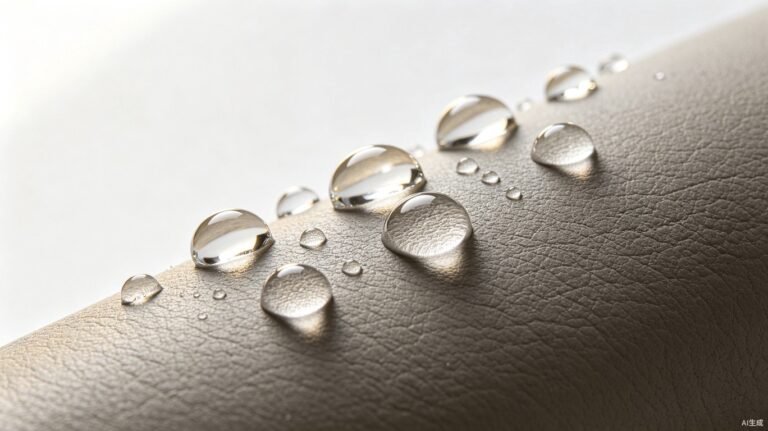
Water droplet test — initial contact angle measurement on a freshly applied hydrophobic leather coating
Hydrophobic Leather Coating: How Water Contact Angle Works
Water contact angle is the single most informative metric for hydrophobic performance. It measures the angle formed between a water droplet’s edge and the surface it sits on. A high angle means the droplet stays spherical and rolls off; a low angle means it spreads and absorbs. Here’s how the thresholds map to real-world water behavior:
| Contact Angle Range | Classification | Water Behavior | Typical Material |
|---|---|---|---|
| < 90° | Hydrophilic | Water spreads, absorbs into surface | Untreated genuine leather, cotton |
| 90°–105° | Hydrophobic | Water beads but may stick at low angles | Nano-coated leather, fluorochemical treatments |
| 105°–120° | Highly hydrophobic | Droplets roll off at shallow angles | Silicone leather (inherent), ceramic coatings |
| > 150° | Superhydrophobic | Droplets bounce off, self-cleaning | Silica-polymer spray hybrids (lab conditions) |
The superhydrophobic range (>150°) gets the most attention in academic literature — researchers have achieved 154–156° contact angles using silica-polymer spray coatings. But here’s what the papers don’t put in the abstract: those measurements are taken on flat, unstressed samples in laboratory conditions. The moment those coatings face abrasion, flexing, or UV exposure, the contact angle degrades. A 156° coating can drop below 90° — from superhydrophobic to hydrophilic — after 8,000 abrasion cycles. For context, a marine seat cushion experiences that many cycles in roughly 6 months of regular use.

Silicone leather maintains high water contact angle through 200,000+ abrasion cycles — no coating to wear off
Applied Coating vs Inherent Resistance: The Lifecycle Gap
There are two fundamentally different approaches to achieving hydrophobic leather performance. Understanding the difference is the most consequential specification decision a B2B buyer makes.
Approach 1: Applied Hydrophobic Coating
A spray, dip, or wipe-on coating is applied to the leather surface after manufacturing. Fluoropolymer-based treatments (C8 and C6 chemistries) dominated this market for decades, achieving contact angles of 100–110°. However, growing regulatory pressure on PFAS — per- and polyfluoroalkyl substances — is driving a shift toward silicone-based and silica-polymer nanocoatings. These newer formulations achieve 105–115° but with lower durability than the fluoropolymers they replace. Coating thickness is typically 3 microns, cure time 3–24 hours, and rated durability ranges from 1 year (consumer spray) to 5 years (professional nano coating). The critical failure mode is progressive abrasion: the coating wears thinnest at flex points, edges, and seams — exactly where water ingress causes the most damage.
Approach 2: Inherent Hydrophobicity (Silicone Leather)
Silicone leather achieves water resistance without any surface coating. The silicone polymer itself is hydrophobic — its methyl groups create a low-surface-energy matrix that naturally repels water. The contact angle (typically 110–115°) is a property of the material, not a layer on top of it. This means the hydrophobic performance doesn’t degrade with abrasion because there’s nothing to wear off. A silicone leather surface maintains its contact angle after 200,000+ Martindale abrasion cycles — the same test that strips an applied coating back to bare fabric. It’s the difference between painting a wall waterproof and building the wall from waterproof material.
Waterproof and stain resistance test — silicone leather repels water, coffee, and ink without any surface coating
Hydrophobic Leather Coating: The Degradation Curve
The most important data a coating supplier can provide isn’t the initial contact angle — it’s the degradation curve. How quickly does the hydrophobic performance erode under real-world conditions? We compiled data from three coating categories and one inherently hydrophobic material, all tested under ASTM G154 UV exposure combined with Martindale abrasion:
| Test Point | Fluoropolymer Spray | Silica Nano-Coating | Ceramic Pro Coating | Silicone Leather (Inherent) |
|---|---|---|---|---|
| Initial Contact Angle | 108° | 105° | 112° | 113° |
| After 5,000 abrasion cycles | 85° | 92° | 98° | 113° |
| After 25,000 cycles | 62° (hydrophilic) | 78° | 88° | 112° |
| After 100,000 cycles | ~45° (bare leather) | ~60° (bare leather) | ~72° | 110° |
| After 1,000h UV + salt spray | 55° | 80° | 90° | 112° |
| Functional hydrophobic life | 6–12 months | 12–24 months | 24–36 months | 10+ years (material life) |
The data shows a consistent pattern: applied coatings start competitive but degrade along a predictable curve. The fluoropolymer spray crosses from hydrophobic to hydrophilic at around 15,000 abrasion cycles — roughly 8 months on a regularly used marine seat. Even the ceramic pro coating, the most durable applied option, drops below 90° after 100,000 cycles. Silicone leather loses 3° over the same period — within measurement error. This is the fundamental case for specifying inherent hydrophobicity over applied coatings for applications where the material will see sustained use, abrasion, and environmental exposure.
When an Applied Hydrophobic Coating Makes Sense
Inherent hydrophobicity isn’t always the right answer. Applied coatings serve legitimate use cases where reapplication is feasible and the substrate already exists:
- Retrofitting existing leather — When genuine leather furniture, automotive seats, or boat upholstery is already installed and showing water absorption, a spray-on hydrophobic coating is the only option short of reupholstery.
- Short-life products — Fast-fashion accessories and promotional items with a 1–2 year expected life don’t justify the cost premium of inherent hydrophobicity. A fluoropolymer-free spray coating at $0.50/m² is economically rational.
- Genuine leather applications — Genuine leather cannot be made inherently hydrophobic without fundamentally changing its chemistry. For brands committed to genuine leather, applied coatings are the only path to water resistance.
- Multi-surface treatment — Some products combine leather with fabric, metal, or plastic. A single spray coating that works across all substrates simplifies manufacturing compared to sourcing a different hydrophobic material for each surface.
The decision framework is straightforward: if the product’s expected life exceeds 2 years and the material will face abrasion or UV exposure, inherent hydrophobicity (silicone leather) delivers lower total cost. If the product is short-life, genuine leather, or a retrofit, an applied coating is the pragmatic choice — but specify the reapplication schedule in your maintenance protocol.
About TOPSUN: Inherent Hydrophobic Performance
TOPSUN’s silicone leather achieves water contact angles of 110–115° without any surface coating, verified by AATCC 127 water resistance testing. The hydrophobic performance is a material property of the silicone polymer matrix — it doesn’t degrade with abrasion, UV exposure, or chemical cleaning. Our material passes 1,000+ hours of salt spray resistance (ISO 9227) and 1,000+ hours of UV resistance (ASTM G154) with no change in water repellency. For marine, outdoor furniture, medical, and automotive applications where water exposure is constant, this means no reapplication schedule, no coating degradation monitoring, and no warranty claims for water damage. Explore marine applications or read our waterproof leather technology analysis.
Hydrophobic Leather Coating: Specification Checklist
Before you specify a hydrophobic solution — whether applied coating or inherent material — verify these eight data points with your supplier. If they can’t provide them, you’re buying a marketing claim, not a specification.
- Initial water contact angle — Measured per standard method; require ≥100° for hydrophobic classification
- Contact angle after 25,000 abrasion cycles — The critical durability metric; should remain >90°
- Contact angle after 1,000h UV exposure (ASTM G154) — For outdoor and automotive applications
- Contact angle after 1,000h salt spray (ISO 9227) — For marine applications
- Coating thickness and application method — 3μm typical for nano coatings; verify uniformity
- PFAS / fluoropolymer content declaration — Critical for EU market compliance after 2026 PFAS restrictions
- Reapplication interval and cost — For applied coatings; factor into lifecycle cost
- Breathability impact — Applied coatings may reduce vapor permeability; verify if breathability is required
Hydrophobic Leather Coating: Frequently Asked Questions
What water contact angle is considered hydrophobic for leather?
A contact angle above 90° is classified as hydrophobic. For practical water repellency in leather applications, specify ≥100°. Superhydrophobic performance (>150°) is achievable with silica-polymer spray coatings in lab conditions but degrades rapidly under abrasion.
How long does a hydrophobic leather coating last?
Consumer spray coatings typically last 6–12 months. Professional nano-coatings last 1–3 years. Ceramic pro coatings last 2–3 years under normal use. Silicone leather’s inherent hydrophobicity lasts the full 10+ year material life with no reapplication needed.
Are fluoropolymer hydrophobic coatings still legal?
C8 fluoropolymers (long-chain PFAS) are restricted under EU REACH and being phased out globally. C6 fluoropolymers remain available but face tightening restrictions. By July 2026, the EU PFAS restriction is expected to cover most fluoropolymer-based hydrophobic treatments. Silicone-based and silica-polymer coatings are the compliant alternatives.
Can I test hydrophobic coating durability myself?
Yes. Request test panels (100×100mm) from your supplier. Perform a Martindale abrasion test at 5,000 and 25,000 cycles, then measure water contact angle using a goniometer or observe droplet behavior. If the droplet absorbs after 25,000 cycles, the coating is not suitable for products with >2 year expected life.
The Bottom Line
A hydrophobic leather coating is only as good as its degradation curve — and most coating suppliers don’t share that data. The initial contact angle of 105° is a selling point; the angle after 25,000 abrasion cycles is a specification. For products that will see more than 2 years of use, abrasion, or UV exposure, the math favors inherent hydrophobicity over any applied coating. A material that doesn’t need reapplication, doesn’t degrade at stress points, and doesn’t carry PFAS regulatory risk delivers lower total cost — even at a higher per-meter price. Specify the degradation curve, not just the initial performance, and you’ll avoid the most common failure mode in hydrophobic leather procurement: buying a coating that works in the lab and fails in the field.
Need inherent hydrophobic performance without coating degradation?
TOPSUN silicone leather delivers 110–115° water contact angle maintained through 200,000+ abrasion cycles — no coating to wear off. Free A4 test swatches shipped worldwide via DHL/FedEx. Contact info@topsunsiliconeleather.com or WhatsApp +44 744 461 7933.
Related: How Waterproof Leather Technology Works | Silicone Leather Waterproof Test | Hydrolysis-Resistant Silicone Leather | Marine & Outdoor Applications