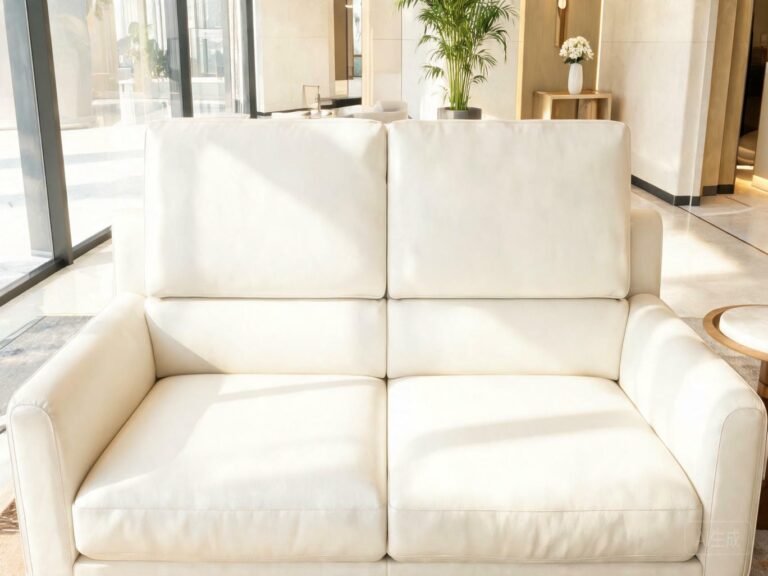
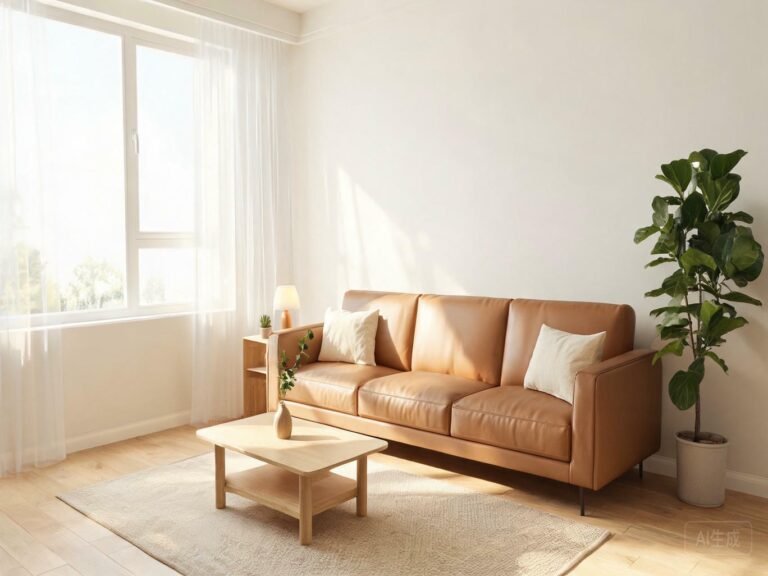
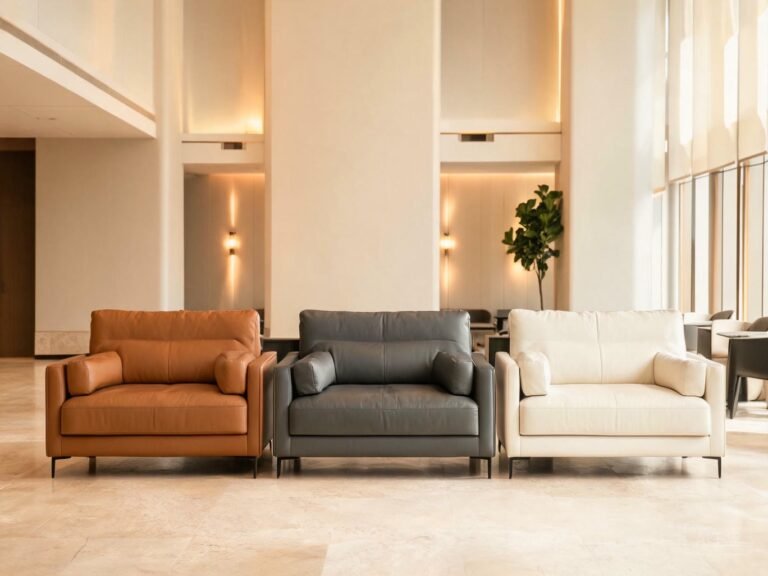
Red brown leather carries an unmistakable warmth — the rich patina of a well-worn Chesterfield, the deep tones of a luxury hotel lobby, the earthy sophistication of a bespoke furniture collection. But that warmth comes with a hidden cost: genuine red brown leather fades to orange-brown within 12-18 months of UV exposure, particularly in south-facing hospitality settings. The tanning oils oxidize, the iron oxide pigments degrade, and the color that sold the design on day one becomes the detail that dates it by year two.
TOPSUN manufactures fade-resistant red brown silicone leather with synthetic iron oxide pigments achieving ISO 105-B06 Grade 4-5 color fastness — engineered for luxury hospitality, furniture, and interior design applications where color integrity defines brand perception across a 10+ year service life.
Why Red Brown Leather Fades
The fading mechanism in genuine red brown leather is twofold. First, the natural tannins and oils used in chrome tanning oxidize under UV exposure — a photochemical reaction that shifts the leather’s undertone from warm red-brown to a dull orange-brown. Second, the iron oxide pigments applied as surface coatings during the finishing process degrade at the molecular level. Iron (III) oxide, the compound responsible for red-brown coloration, undergoes photo-reduction under prolonged UV exposure, converting to iron (II) compounds that present as visibly lighter and more orange tones.

In silicone leather, the colorfastness advantage is structural. Red brown pigments are compounded into the liquid silicone rubber before the coating process — not applied as a surface finish. This integral pigmentation means the color runs through the full 0.23-2.0mm thickness of the material. The Si-O backbone of polydimethylsiloxane carries 452 kJ/mol bond energy — significantly higher than the 348 kJ/mol C-C bonds in polyurethane — meaning the polymer itself does not yellow, crack, or degrade under the UV radiation that breaks down genuine leather and PU alternatives.
| Property | Genuine Red Brown Leather | Silicone Red Brown Leather | Advantage |
|---|---|---|---|
| UV Color Fastness | Grade 2-3 at 200 hrs | Grade 4-5 at 1,500+ hrs | 5× longer color stability |
| Delta E (10-year sim.) | 3.0-5.0 (visible shift) | ≤ 1.0 (imperceptible) | Below human perception threshold |
| Pigment Degradation | Iron oxide photo-reduction | No degradation — integral pigment | Structural color permanence |
| Polymer Yellowing | Yes — tanning oils oxidize | No — Si-O backbone inert | No secondary color shift |
| Martindale Abrasion | 25,000-50,000 cycles | ≥ 200,000 cycles | 4× wear resistance |
| Service Life | 3-5 years (fading/cracking) | 10+ years | 2-3× lifecycle |
Synthetic Iron Oxide Pigment Stability
The difference between natural and synthetic iron oxide pigments is critical to understanding why silicone red brown leather holds color where genuine leather cannot. Natural iron oxides — mined from the earth and used in traditional leather finishing — contain trace impurities including manganese, titanium, and aluminum silicates that accelerate photo-degradation. These impurities act as photocatalysts, accelerating the breakdown of the pigment’s crystal structure under UV exposure.

Synthetic iron oxides, manufactured under controlled precipitation conditions, achieve purity levels exceeding 99.5%. The crystal structure is uniform — alpha-Fe₂O₃ (hematite) for red-brown tones — with no trace impurities to catalyze degradation. When these synthetic pigments are compounded into liquid silicone rubber at 160-180°C during the coating process, they become structurally locked into the polymer matrix. UV radiation cannot break the Si-O bonds surrounding the pigment, and without polymer degradation to expose the pigment to oxidative breakdown, the red brown color remains stable indefinitely.
Genuine leather Sample A: Delta E 3.2 at 200 hrs, 5.1 at 500 hrs — visible orange-brown shift
PU Sample B: Delta E 2.8 at 200 hrs, 4.5 at 500 hrs — surface coating degradation
Silicone Sample C: Delta E 0.7 at 200 hrs, 0.9 at 1,500 hrs — imperceptible shift, Grade 4-5
Red Brown Leather in Hospitality and Furniture Design
In hospitality procurement, red brown leather signals warmth, tradition, and permanence — qualities that hotel designers specify for lobby seating, restaurant booths, and guest room accent chairs. The problem is that hospitality environments subject these surfaces to 12-16 hours of daily UV exposure through windows, combined with cleaning chemical cycles that accelerate pigment degradation. A red brown leather sofa specified for a south-facing lobby can show visible fading within a single season, creating a mismatch between newly installed and aged pieces that undermines the design intent.

Silicone red brown leather eliminates this problem. With UV resistance verified at 1,000+ hours per ASTM G154 (the equivalent of 7-10 years of real-world indoor UV exposure), the color specified at installation is the color guests see at year five, year seven, and year ten. For procurement teams managing 200-500 room properties with multi-year renovation cycles, this color stability translates directly to reduced replacement costs and eliminated warranty claims for color degradation.

Silicone leather UV resistance — color fastness performance under accelerated aging
Batch-to-Batch Color Consistency
Beyond UV stability, B2B procurement teams specifying red brown leather face a second challenge: batch-to-batch color consistency. When a 10,000-meter order is split across three production runs, the red brown must match across every roll — or the furniture manufacturer faces visible color mismatches on assembled pieces. TOPSUN addresses this through spectrophotometer-controlled color matching, with every production batch verified against the approved Pantone or RAL reference to Delta E ≤ 1.0.
For teams specifying custom textures and colors, the red brown silicone leather is available in finishes from smooth to pebbled to deeply embossed, with thickness options from 0.23mm for furniture wrapping to 2.0mm for heavy-duty seating. Each specification carries the full certification chain — ISO 10993 biocompatibility, REACH compliance, FDA food contact — providing audit-ready documentation for regulated procurement environments. See the environmental compliance documentation for zero-VOC and solvent-free process verification.
Specifying red brown leather? Get the color fastness data first.
Pantone-accurate red brown silicone leather swatches with ISO 105-B06 color fastness certification. Free A4 samples shipped worldwide.
FAQ
Why does red brown leather fade over time?
Genuine red brown leather fades through two mechanisms: oxidation of tanning oils under UV exposure, which shifts the undertone to orange-brown, and photo-reduction of natural iron oxide pigments, which lightens the red-brown color. Natural iron oxides contain trace impurities (manganese, titanium) that act as photocatalysts, accelerating pigment breakdown. Silicone leather uses 99.5% pure synthetic iron oxide pigments compounded integrally into the silicone polymer, preventing both mechanisms.
How does silicone leather maintain red brown color stability?
Silicone leather’s Si-O backbone carries 452 kJ/mol bond energy — higher than the 300-410 kJ/mol energy carried by UV radiation in the 290-400nm range. UV cannot break the polymer bonds, so the polymer does not yellow or degrade. Synthetic iron oxide pigments are locked into the polymer matrix during the 160-180°C coating process, preventing photo-reduction. The result: ISO 105-B06 Grade 4-5 color fastness after 1,500+ UV hours, with Delta E ≤ 1.0 — imperceptible to the human eye.
For procurement teams specifying red brown leather in hospitality, furniture, or interior design projects, color stability is the specification that determines whether a design intent survives contact with reality. TOPSUN’s silicone red brown leather — with synthetic iron oxide pigments, ISO 105-B06 Grade 4-5 color fastness, Delta E ≤ 1.0 batch consistency, and a 10+ year UV-stable service life — provides the documentation and material science to ensure the color you specify on day one is the color your guests see in year ten. Request the color fastness report and Pantone-matched samples to begin your specification.
Fade-resistant red brown leather — color stability verified.
Free A4 sample swatches shipped worldwide via DHL/FedEx. Full ISO 105-B06 color fastness report included.