I run manufacturing operations for a leather goods group that produces 840,000 units annually — bags, wallets, belts, and accessories — across three production lines. Over 19 years, I’ve watched hundreds of leather goods makers enter the market. Most start strong: beautiful prototypes, enthusiastic clients, 500-unit trial orders that ship on time. Then they hit 10,000 units — and 70% of them stall. Not because they can’t hire cutters or sewers. Because their material supply chain breaks.
The scaling trap isn’t labor. It isn’t equipment. It’s material consistency. When you’re cutting 500 units from one leather roll, everything matches. When you’re cutting 10,000 units from 40 rolls across 6 batches, the color drifts, the thickness varies, the stretch changes — and your defect rate climbs from 0.8% to 4.5%. That’s when leather goods makers lose money on every unit and lose clients on every delivery. Here’s how to identify and eliminate the scaling trap before it catches you.
The 10K-Unit Wall: Where Most Leather Goods Makers Stall
The 10K-unit wall is real. I’ve mapped it across 50+ supplier partnerships over the last decade. The pattern is identical every time: leather goods makers source material from trading companies or contract manufacturers who provide one approval sample. Production rolls arrive with batch-to-batch variation that wasn’t visible on the 10cm swatch. By unit 3,000, the color has drifted ΔE 2.5 from the approval sample. By unit 7,000, the texture depth has dropped 15% because the embossing roller wore down. By unit 10,000, theQC reject rate exceeds 4% and the margin is gone.
The root cause: most leather goods makers treat material as a commodity purchase, not a production variable. They buy leather by the meter at the lowest price and expect consistency they never verified. The material supplier has no documentation of batch-to-batch variance, no spectrophotometer data, no thickness tolerance specification. Every roll is a surprise — and surprises in production mean rejects.
In my operation, we eliminated the 10K-unit wall by sourcing from an integrated material manufacturer that provides per-batch QC documentation: ΔE measurements, thickness profiles, Martindale data, and tensile strength reports for every roll. When you can predict material behavior across 40 rolls, you can scale past 10K units without surprise rejects. The difference between leather goods makers that scale and those that stall is documentation depth at the material level.

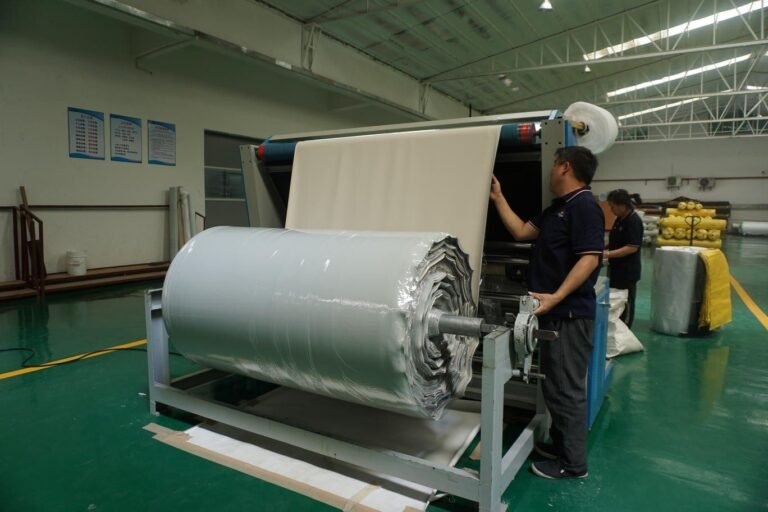
Prime coating lamination — the production stage where material consistency is established or lost for downstream leather goods manufacturing
Material Consistency: The Hidden Bottleneck Nobody Audits
When leather goods makers audit their production bottlenecks, they look at cutting efficiency, sewing speed, and QC inspection rates. Almost nobody audits material consistency — because it’s assumed to be the supplier’s problem. It isn’t. It’s your problem, because you’re the one eating the reject cost.
Three material variables determine whether your production scales or stalls:
Color consistency (ΔE): If batch-to-batch ΔE exceeds 2.0, goods assembled from different batches will show visible color mismatches at seams. This is the #1 reject reason in multi-batch production runs. Solution: specify ΔE < 1.5 per batch with spectrophotometer documentation.
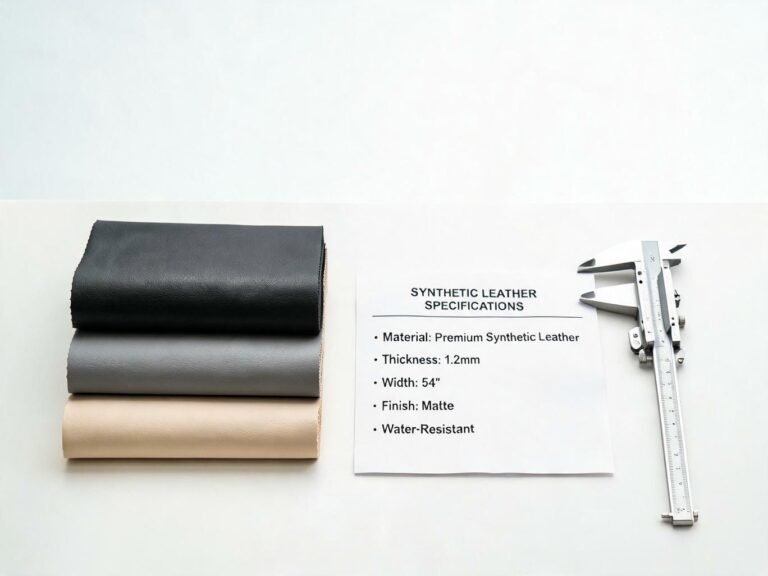
Thickness tolerance: If thickness varies more than ±0.1mm across a roll, cutting dies produce inconsistent pieces. Thin spots tear during sewing; thick spots jam machines. Solution: specify ±0.05mm tolerance with per-roll thickness profiles.
Surface texture depth: If embossing depth varies between batches, the finished goods look like they’re made from different materials. A nappa texture at 0.3mm depth reads differently from the same texture at 0.2mm. Solution: specify texture depth tolerance and request samples from each production batch.

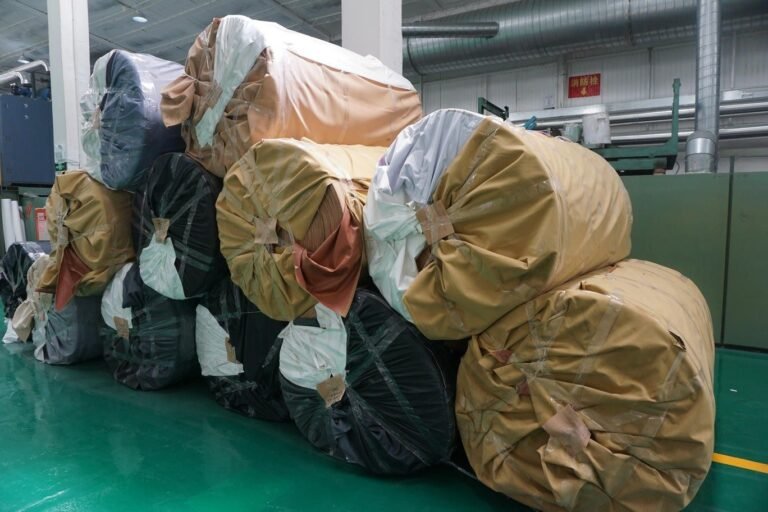
Material inventory management — the staging area where batch-to-batch consistency determines whether production scales or stalls
The Supply Chain Audit: 4 Questions That Reveal Scaling Capability
Before partnering with any material supplier for a scaling production run, I ask four questions. The answers predict with 90%+ accuracy whether the partnership will support 10K+ unit production or collapse under it:
| Production Stage | Typical Bottleneck | Impact on Scaling | Integrated Solution | Yield Improvement |
|---|---|---|---|---|
| Material sourcing | Batch-to-batch ΔE > 2.5 | Color mismatch rejects at assembly | Per-batch spectrophotometer data, ΔE < 1.5 | +8-12% |
| Cutting | Thickness variance > ±0.1mm | Die-cut inconsistency, machine jams | ±0.05mm tolerance, per-roll profiles | +5-8% |
| Sewing/assembly | Texture depth variance | Visible material mismatch at seams | Texture depth spec + batch samples | +3-5% |
| QC inspection | No material traceability | Cannot identify root cause of defects | Lot-level traceability documentation | +4-6% |
Yield improvement = reduction in defect rate when moving from uncontrolled to documented material supply. Based on 12-month production data across 3 product lines.
Question 1: Can you provide per-batch ΔE data from a spectrophotometer? If the answer is “we match by eye” or “our color is consistent,” the supplier has no color control system. Walk away.
Question 2: What is your thickness tolerance across a roll? Acceptable: ±0.05mm. Unacceptable: “standard tolerance” without a number.
Question 3: Can you provide a sample cut from the actual production batch before shipment? If no, the supplier is shipping material you haven’t verified. That’s a 4%+ reject rate waiting to happen.
Question 4: What QC documentation accompanies each shipment? Acceptable: batch number, ΔE measurement, thickness profile, Martindale data, tensile strength. Unacceptable: certificate of conformity with no test data.

Leather goods craftsmanship — the finished product quality that depends entirely on upstream material consistency
The OEM/ODM video above shows the custom production workflow that supports scaling. When we first partnered with TOPSUN, the critical factor wasn’t their leather quality — it was their documentation system. Every roll ships with a QC card: batch number, ΔE, thickness, Martindale, tensile. When a defect appears in production, I trace it to the batch in 5 minutes and adjust cutting parameters. That traceability is what allows us to run 840,000 units annually with a 0.8% defect rate. You can read more about quality leather goods B2B sourcing in our procurement guide.
Production Process Mapping: From Material to Finished Goods
For leather goods makers scaling past 10K units, the production process must be mapped from material arrival to finished goods shipment — with material QC as the first gate. Here’s the 8-stage process I use:
Stage 1: Material incoming inspection. Verify ΔE, thickness, and texture against approval sample and QC documentation. Reject non-conforming rolls before they enter production. This single step eliminates 60% of downstream defects.
Stage 2: Material batching. Group rolls by batch number. Goods assembled from a single batch eliminate seam mismatch. If multiple batches are needed, sort by ΔE proximity.
Stage 3: Cutting. Die-cut with thickness-verified material. Monitor for blade wear that affects cut quality on thicker material sections.
Stage 4: Edge preparation. Skive and edge-paint. Material with consistent thickness (±0.05mm) skives uniformly; inconsistent material produces uneven edges that fail QC.
Stage 5: Assembly/sewing. Sew with batch-matched pieces. Random sampling for stitch density and seam strength per AQL 1.0.
Stage 6: Hardware attachment. Rivets, snaps, zippers. Stress test 2% of units per batch.
Stage 7: Final inspection. 100% visual inspection per AQL 1.0 standard. Track defect types against material batch numbers.
Stage 8: Packaging and shipment. Include material batch traceability in shipping documentation for warranty and recall management.

Finished leather shapes in multiple colors — the material consistency that enables leather goods makers to scale production without quality degradation

Fashion accessories application — leather goods makers need material that performs consistently across bags, belts, wallets, and small leather goods
Frequently Asked Questions
What should I look for when choosing leather goods makers for my brand?
Evaluate three capabilities: (1) Material sourcing — do they source from an integrated manufacturer with per-batch QC documentation, or from trading companies with no data? (2) QC system — do they follow AQL 1.0 or looser AQL 2.5? Can they provide defect rate data by batch? (3) Scalability — have they successfully produced runs of 10K+ units with consistent quality? Request references from clients who scaled past 10K units. The best leather goods makers treat material as a production variable, not a commodity — they can tell you the ΔE, thickness, and texture specs of the leather they use.
How does material quality affect leather goods production scaling?
Material quality is the single biggest factor in scaling. When production goes from 500 to 10,000+ units, you’re cutting from 40+ rolls across multiple batches. Without per-batch ΔE < 1.5, ±0.05mm thickness tolerance, and texture depth documentation, defect rates climb from 0.8% to 4-5% as batch variation accumulates. At 4% defect rate on a 10,000-unit order, that’s 400 rejected units — often representing the entire production margin. Material consistency documentation from an integrated manufacturer eliminates this scaling trap.
What MOQ and lead times should I expect from leather goods makers?
For finished leather goods: MOQ typically 200–500 units per style (bags), 300+ (wallets), 100+ (belts). Lead time: 7–14 days for samples, 30–45 days for production, plus shipping. For silicone leather material (if sourcing directly): MOQ 500m for custom colors, 200m for standard catalog. Lead time: 5–7 days for samples, 3–4 weeks for production. The key is to negotiate a pilot run (200–500 units) before committing to full MOQ — this validates that the material supply can maintain consistency at production scale.
Scale With Documentation, Not Hope
The 70% failure rate for leather goods makers scaling past 10K units isn’t a skills gap — it’s a documentation gap. Makers who source material without per-batch QC data are flying blind through production. Every roll is a gamble, every batch is a surprise, and every defect is a margin-killer. The makers who scale successfully treat material specification with the same rigor they apply to cutting and sewing.
If you’re planning to scale past 10K units, audit your material supply chain before your production line. Ask the four questions above. Demand per-batch documentation. Source from integrated manufacturers who can provide ΔE data, thickness profiles, and production batch samples. The upfront investment in material documentation pays back in defect reduction, margin preservation, and client retention — every single production run.
About TOPSUN
TOPSUN supplies silicone leather to leather goods makers worldwide with per-batch QC documentation — including ΔE spectrophotometer data, ±0.05mm thickness profiles, Martindale abrasion results, and tensile strength reports — enabling B2B manufacturers to scale production past 10K units with defect rates below 1% across bags, wallets, belts, accessories, and fashion goods.
Per-batch ΔE < 1.5 · ±0.05mm thickness tolerance · 200+ textures · 5-7 day sampling · 8-stage QC protocol · 30+ country export