If you’re a furniture manufacturer, interior designer, or upholstery shop, you’ve probably noticed something odd about how leather upholstery materials are sold. Genuine leather is sold by the hide or by the square foot — irregular shapes, variable sizes, inconsistent quality across the same hide. Synthetic leather is sold by the yard — uniform rolls, consistent quality, easy to calculate. It’s like comparing apples to oranges, and it makes cost comparison surprisingly difficult.
In this guide, we’re going to make that comparison clear. We’ll walk through how leather upholstery fabric is priced and sold by the yard, how to calculate yield (the single most important factor most buyers get wrong), how genuine leather stacks up against synthetic leather on a real-cost basis, and what to look for when sourcing upholstery leather for commercial projects.
Read Our Furniture Leather Buying Guide
Understanding Leather Upholstery Pricing: By the Hide, By the Foot, By the Yard
The first thing to understand about leather upholstery pricing is that it’s not a single number — it’s a calculation. And the way you calculate it depends on whether you’re buying genuine leather or synthetic leather.
Genuine leather: priced by the hide or square foot
Genuine leather comes from animals, so every hide is a different size and shape. A typical cowhide is about 50–55 square feet, but it’s irregular — it has a belly, a neck, legs, and natural variations in thickness and quality. This means you can’t just use every part of the hide equally for upholstery. For a sofa, you need large, uniform panels from the back and shoulder area (the “bell” of the hide). The belly and flank areas are thinner and stretchier — usable for some parts but not for seat cushions or back panels where consistency matters. The usable yield from a hide for upholstery is typically 60–75% of the total area, depending on the pattern and the grade of leather.
Synthetic leather: priced by the yard or meter
Synthetic leather (PU, PVC, silicone) is manufactured in uniform rolls, usually 54–60 inches wide (1.37–1.52 meters). It’s sold by the linear yard or meter, and the entire width is usable. Because it’s uniform, your yield is essentially 100% — whatever pattern you can lay out on the roll, you can cut. There are no irregular edges, no brand marks, no neck wrinkles to work around. For commercial upholstery projects where consistency and predictability matter, this is a huge advantage.
Converting to a common unit for comparison
To compare genuine leather and synthetic leather pricing, you need to convert both to a usable-yield cost per square foot or per yard. Here’s the math:
| Material | List Price | Usable Yield | Cost per Usable Sq Ft |
|---|---|---|---|
| Top-grain leather (mid-grade) | $4.50/sq ft (hide price) | 65% (upholstery yield) | $6.92/sq ft |
| Full-grain leather (premium) | $7.00/sq ft (hide price) | 55% (more waste from natural marks) | $12.73/sq ft |
| PU synthetic leather (mid-grade) | $12/yard = $2.67/sq ft | 95% (minimal waste) | $2.81/sq ft |
| Silicone synthetic leather (premium) | $25/yard = $5.56/sq ft | 95% (minimal waste) | $5.85/sq ft |
The key takeaway: the gap between genuine leather and synthetic leather is bigger than the list prices suggest, because genuine leather has significantly more waste. When you compare on a usable-yield basis, mid-grade silicone leather costs less than mid-grade top-grain leather — and it outperforms it on durability, stain resistance, and UV stability.

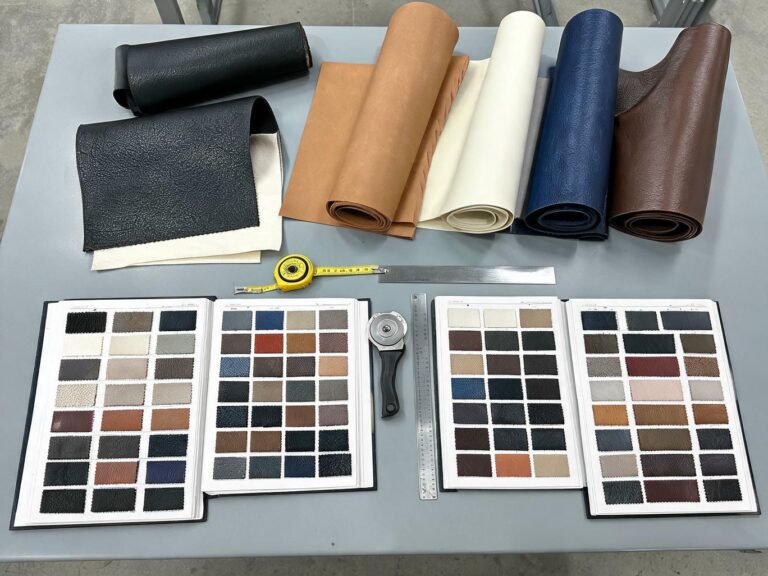
Upholstery fabric swatch selection — synthetic leather is sold in uniform rolls by the yard, making quantity calculation and yield planning straightforward.
Designer tip: Always calculate upholstery material cost based on usable yield, not list price. A $4/sq ft leather with 60% yield is actually $6.67/sq ft of usable material.
How Much Leather Do You Need for Common Upholstery Projects?
One of the most common questions from new upholstery buyers is “how much material do I need?” Here are rough estimates for common furniture pieces, comparing genuine leather (in hides) and synthetic leather (in yards). These are estimates — the exact amount depends on the specific pattern, the size of the piece, and the skill of the upholsterer.
| Furniture Piece | Genuine Leather (Hides) | Synthetic Leather (Yards) | Approx. Material Cost |
|---|---|---|---|
| Dining chair (set of 4) | 1–2 hides | 4–6 yards | Genuine: $250–$550 / Synthetic: $50–$150 |
| Armchair / Club chair | 2–3 hides | 6–8 yards | Genuine: $500–$850 / Synthetic: $75–$200 |
| Loveseat (2-seat) | 3–4 hides | 8–12 yards | Genuine: $750–$1,200 / Synthetic: $100–$300 |
| Sofa (3-seat) | 4–6 hides | 12–16 yards | Genuine: $1,000–$1,800 / Synthetic: $150–$400 |
| Sectional (L-shape) | 6–8 hides | 16–22 yards | Genuine: $1,500–$2,400 / Synthetic: $200–$550 |
| Ottoman | ½–1 hide | 2–3 yards | Genuine: $125–$275 / Synthetic: $25–$75 |
Note: these are rough estimates using mid-grade pricing. Premium full-grain leather could be 2–3x these costs, while budget PU synthetic could be less. The important thing is to work with your supplier and upholsterer to get an accurate quote based on your specific piece — and always order 10–15% extra for waste, mistakes, and future repairs.
For more on furniture material selection, see our furniture and sofa applications guide.

Upholstery production — accurate material estimation is critical for cost control, especially on large commercial projects.
Grades of Leather Upholstery Fabric: What Are You Actually Paying For?
When you buy leather upholstery fabric by the yard (or by the hide), you’ll see it categorized by “grade” — Grade 1, Grade 2, Grade 3, etc. But here’s the thing: there’s no universal grading system. Every manufacturer and supplier defines their grades differently. One company’s Grade 3 might be another company’s Grade 5. So you can’t compare grades across suppliers — you have to look at what’s actually in the material.
That said, here’s what typically differentiates leather grades, from lowest to highest:
- Entry-level (bonded / bicast leather): Made from ground-up leather fibers bonded together with polyurethane and then coated. Looks like leather but doesn’t perform like it. Low cost, short lifespan.
- Mid-range (split leather / corrected grain): Made from the lower layers of the hide, sanded and embossed with a grain pattern. More durable than bonded leather but less natural-looking and less breathable than top-grain.
- Premium (top-grain leather): Made from the top layer of the hide, lightly sanded to remove natural marks. Strong, durable, natural look and feel. The sweet spot for most mid-to-high-end residential furniture.
- Luxury (full-grain leather): The top layer of the hide with no sanding — all the natural grain and marks are intact. The most durable and the most expensive. Develops a beautiful patina over time. Used for high-end and heirloom-quality furniture.
- Specialty (aniline, semi-aniline, nubuck, suede): Finishes that create different looks and feels. Aniline is dyed all the way through with no protective coating (most natural look but stains easily). Nubuck is top-grain sanded to a velvet-like texture. Suede is made from the underside of the hide.
For synthetic leather, the grading is usually based on the coating material, thickness, backing quality, and surface finish. Premium silicone leather is typically in the “premium” or “luxury” tier because it has the highest performance characteristics — even though it costs less than full-grain genuine leather on a usable-yield basis.
Commercial spec tip: For hospitality, office, or other commercial projects, always check the double rub (Wyzenbeek) rating. Commercial grade should be 50,000+ double rubs; heavy commercial should be 100,000+. Silicone leather typically exceeds 200,000 double rubs.

Upholstery showroom display — always evaluate material samples in your actual lighting conditions before specifying.
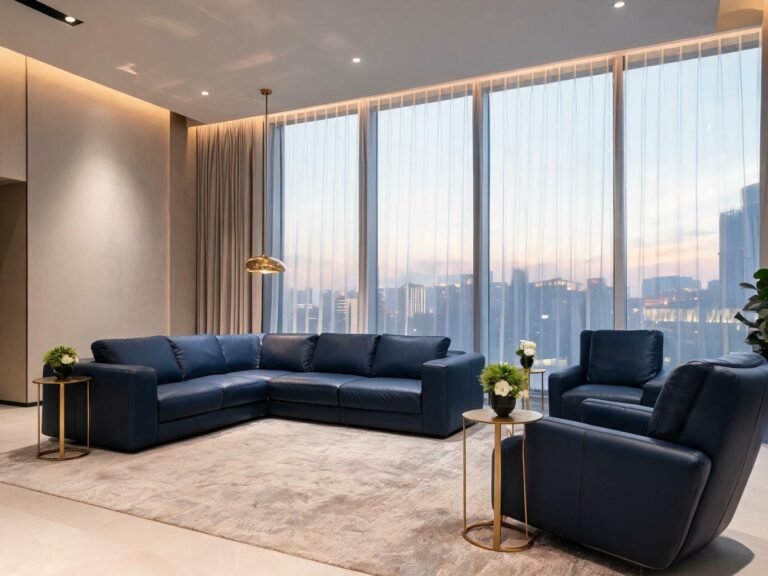
Furniture upholstery application — silicone leather is increasingly specified for commercial furniture where durability and cleanability are critical.
Where to Buy Leather Upholstery Fabric by the Yard
The sourcing channel you choose depends on how much you’re buying, what grade you need, and how much support you want. Here are the main options for B2B buyers.
Direct from the tannery or manufacturer
If you’re buying in volume (50+ hides or 500+ yards), going direct to the tannery or manufacturer will get you the best pricing and the most control over quality and customization. The downside is minimum order quantities — most tanneries won’t sell less than a full hide pack (10–20 hides), and synthetic leather manufacturers typically have MOQs of 300–500 yards per color. You also need to know exactly what you want — they’re manufacturers, not design consultants.
Wholesale distributors
Wholesale distributors (like Moore & Giles, Edelman Leather, or Kravet for genuine leather, and various distributors for synthetic) buy in bulk from manufacturers and sell smaller quantities to the trade. They carry multiple brands and materials, so you can compare options in one place. They usually have showrooms and sales reps who can help with selection. Pricing is higher than direct, but MOQs are lower and you get more service. This is the sweet spot for most furniture manufacturers and design firms.
Online fabric suppliers
Online suppliers like Fabric.com, Etsy fabric shops, and various leather suppliers on Amazon and eBay sell leather and faux leather by the yard to anyone — no trade account needed. The upside is convenience and low minimums (sometimes as low as 1 yard). The downside is pricing is retail, selection can be inconsistent, and you’re usually buying without seeing a physical sample first (photos are notoriously inaccurate for color and texture). Good for small projects and prototyping, not ideal for production.
Trade shows and markets
Trade shows like High Point Market, NeoCon, Heimtextil, and Lineapelle are great places to see and compare materials from many suppliers in person. You can feel the texture, see the color, and talk to company representatives directly. You’ll also discover new products and trends you wouldn’t find online. If you’re serious about upholstery, attending at least one major trade show per year is worth the time and investment.
Order Silicone Leather Upholstery Samples
Frequently Asked Questions
How do you convert leather hides to yards for upholstery?
This is the most common calculation question, and there’s no perfect answer because hides are irregular. But here’s a rough rule of thumb that upholsterers use: one average cowhide (about 50 sq ft) equals approximately 4–5 linear yards of 54″ wide fabric in terms of usable upholstery area. The exact conversion depends on the pattern (how efficiently you can cut it from a hide vs. a roll) and the yield you get from the hide (how many natural marks and defects you have to work around). For estimating purposes, multiply the number of hides by 4.5 to get approximate yardage — but always confirm with your upholsterer or pattern maker before ordering.
What does “commercial grade” upholstery leather mean?
“Commercial grade” is a term that means the material meets certain durability and performance standards for use in commercial settings (offices, restaurants, hotels, etc.). The most common standard is the Wyzenbeek double rub test, which measures abrasion resistance. Residential grade is typically 15,000–30,000 double rubs; commercial grade is 50,000+; and heavy commercial is 100,000+. But abrasion resistance isn’t the only factor — commercial grade also usually means better stain resistance, UV resistance, and cleanability. For high-traffic commercial projects, always look for materials that have been tested to ACT (Association for Contract Textiles) standards or equivalent. Silicone leather is often specified for commercial projects because it typically exceeds 200,000 double rubs and has excellent stain and chemical resistance.
Making the Right Upholstery Material Choice
Buying leather upholstery fabric by the yard (or by the hide) is more complicated than most people think. It’s not just about picking a color and a price — you have to think about yield, grading, durability, cleaning, and how the material will perform in its intended environment.
The most common mistake is comparing materials based on list price alone. When you factor in yield, durability, and maintenance costs, the “more expensive” material upfront often ends up being the better value over time. A premium silicone leather that costs $25/yard and lasts 15 years is a better value than a $10/yard PU that needs to be replaced in 5 years — and it’s a better value than $4.50/sq ft genuine leather when you account for hide waste.
Always order samples. Always test in your actual environment. And always calculate total cost of ownership, not just upfront cost.
Get a Custom Upholstery Material Quote
About TOPSUN
TOPSUN supplies premium silicone upholstery leather by the yard to furniture manufacturers, contract upholsterers, and interior design firms — with 54″ wide rolls, 300-yard MOQ for custom colors, and stocked colors available from 10 yards.
All materials are tested to ACT and Wyzenbeek standards (200,000+ double rubs), with full data sheets and color cards available. Contact us for custom color matching and bulk pricing for commercial projects.