Search for “best quality leather” and you’ll drown in marketing claims. Every supplier says their product is “premium,” “top-grade,” or “luxury.” But the reality is that fewer than 10% of leather products on the market are made from full-grain leather — the actual top tier. The rest range from decent top-grain to corrected-grain material with a heavy PU finish that barely qualifies as “real leather” at all.
For B2B buyers who need to specify materials with confidence, the difference matters. A full-grain leather upholstery program and a split-leather program might both be sold as “premium leather,” but they’ll perform differently in the field and reflect differently on your brand. This guide walks through how to identify the best quality leather, how to vet suppliers, and where high-performance synthetic alternatives now compete at the top end of the market.
The Leather Quality Hierarchy: What’s Actually the Best?
Leather quality is determined primarily by which layer of the animal hide is used and how much processing it undergoes. The hide is thickest at the surface (the grain side) and gets progressively weaker and more fibrous toward the flesh side. Here’s the hierarchy from highest to lowest quality:
| Quality Tier | What It Is | Tensile Strength | Typical Use |
|---|---|---|---|
| 1. Full-Grain Leather | Topmost layer of hide, minimally processed, natural grain intact | 20-25 MPa | Luxury goods, heirloom furniture, saddlery |
| 2. Top-Grain Leather | Top layer sanded/buffed, pigmented finish applied | 15-20 MPa | Designer furniture, automotive, fashion |
| 3. Corrected-Grain Leather | Lower grade hide, heavy sanding, embossed artificial grain | 10-15 MPa | Mid-range furniture, accessories |
| 4. Split Leather (Genuine) | Fleshy lower layers, coated with PU and embossed | 5-10 MPa | Budget goods, belts, wallets |
| 5. Bonded Leather | Leather scraps/fibers bonded with adhesive | 2-5 MPa | Lowest-cost items, bookbinding |

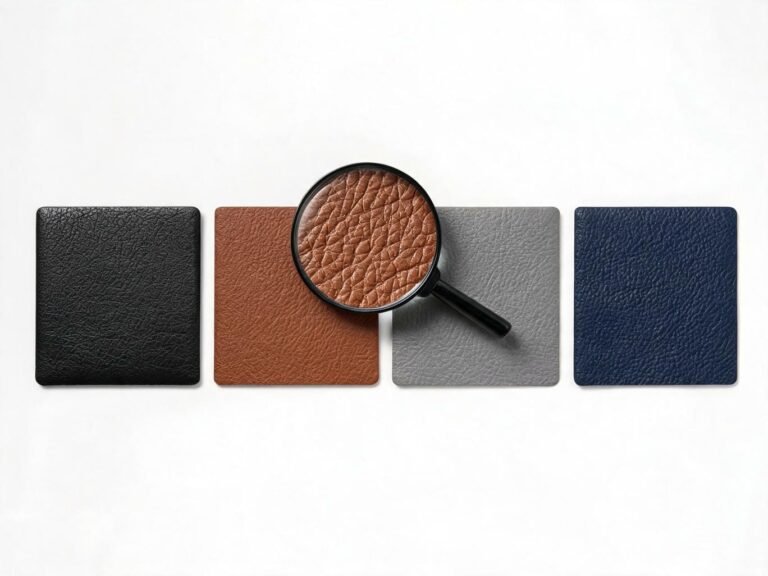
Premium leather samples showing consistent grain and color quality
Full-grain leather is universally recognized as the best quality leather. It includes the complete grain layer of the hide, which has the tightest fiber structure and therefore the highest strength. Because it’s minimally processed, it retains all the natural markings — healed scars, pore variation, texture irregularities — that make each piece unique. Over time, full-grain leather develops a patina that many consider a mark of authenticity and quality.
Red flag: If a supplier labels their product “genuine leather” with no grade specified, assume it’s split leather — the lowest grade of real leather. Always require the specific grade on your specification sheet.
7 Signs You’re Looking at the Best Quality Leather
How do you tell full-grain from corrected-grain when both arrive as finished samples? These visual and tactile indicators are what experienced leather buyers look for:
- Irregular, non-repeating grain pattern. Full-grain leather has a random, organic pore structure. If you look closely and see a repeating pattern — especially one that aligns perfectly across a large area — it’s embossed, not natural grain.
- Natural imperfections. The best quality leather shows subtle healed scars, slight color variation, and visible follicle texture. A perfectly flawless surface is actually a sign of heavy processing, not high quality.
- Same color through the edge cross-section. Cut the edge and look at the cross-section. Full-grain leather shows consistent color from surface to fiber core. Top-grain and corrected-grain have a distinct pigmented skin layer on top that’s a different shade from the body.
- Leathery smell, not chemical. High-quality vegetable-tanned full-grain leather has a distinctive, earthy leather aroma. Heavy chemical or plastic odors indicate solvent-based finishes and lower-grade material.
- Absorbs water slowly. Put a small drop of water on the surface. Full-grain leather will absorb it within 10-30 seconds (the water darkens the surface). Heavily finished or PU-coated leather will bead up and stay on the surface.
- Substantial, dense feel. Quality leather has weight and substance. Thin, flimsy leather that feels like cardboard is usually split leather with a thick coating to simulate thickness.
- Third-party test data. The best quality leather suppliers can provide independent lab reports for tensile strength, tear resistance, color fastness, and abrasion. If a supplier can only show marketing brochures, that’s not a quality signal.

Laboratory testing provides objective quality data that visual inspection alone cannot
In our experience working with procurement teams across multiple industries, the #1 mistake in leather sourcing is relying on visual inspection alone. A skilled finisher can make corrected-grain leather look surprisingly close to full-grain under showroom lighting. The only way to be certain is to review actual test data — ISO 11640 for abrasion, ISO 17228 for tear strength, and ISO 105 for color fastness. A supplier who can’t produce these reports is not a supplier of the best quality leather.
Vetting Suppliers: A B2B Quality Checklist
Finding the best quality leather means finding the right supplier. These are the criteria we recommend using when vetting leather manufacturers for B2B programs:
| Vetting Criterion | What to Look For | Why It Matters |
|---|---|---|
| Certifications | ISO 9001 quality management, ISO 14001 environmental, LWG (Leather Working Group) for tanneries | Confirms standardized processes and environmental compliance |
| In-House Testing | On-site lab with abrasion, tear, colorfastness, and flex testing equipment | Means quality is monitored throughout production, not just at final inspection |
| Sample Process | Detailed tech packs, multiple revision rounds, pre-production sample approval | Rigorous sampling prevents costly production mismatches |
| Vertical Integration | Controls tanning, finishing, and production in-house rather than outsourcing | Better quality control, traceability, and consistency |
| Production Capacity | Demonstrated ability to handle your volume with consistent lead times | Scalability prevents quality drops during ramp-up periods |
| Reference Clients | Established brands in your industry that you can contact | Real-world validation of quality and reliability |

Consistent coloring across a production run is a hallmark of quality manufacturing
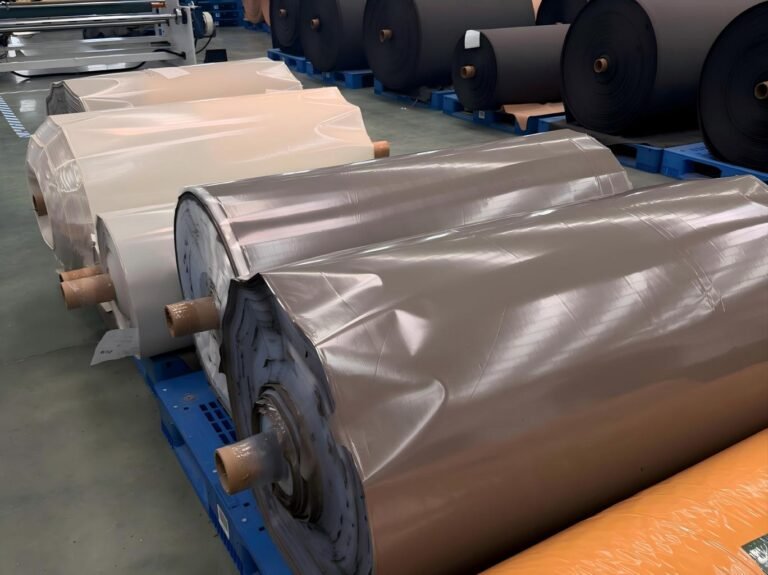
Quality control processes that separate top-tier material suppliers from the rest
When “Best Quality” Doesn’t Mean Natural Leather
Here’s a perspective that surprises many traditional procurement teams: for certain applications, the best quality leather isn’t leather at all. Advanced synthetic leathers — particularly silicone leather — have reached a performance level that competes with and sometimes exceeds natural leather in measurable categories.
Consider these data points from independent testing and industry studies:
| Performance Metric | Full-Grain Leather | Premium Silicone Leather | Best Quality? |
|---|---|---|---|
| Abrasion Resistance | 28,000-35,000 cycles (SAE J2450) | 200,000+ cycles (Martindale) | Silicone wins |
| UV / Fade Resistance | Poor (fades in sunlight) | Excellent (no fading) | Silicone wins |
| Water / Stain Resistance | Absorbs moisture, stains easily | 100% waterproof, stain-proof | Silicone wins |
| Natural Patina / Aesthetic | Excellent (unique aging) | Good (consistent appearance) | Leather wins |
| Maintenance Required | Regular conditioning (2x/year) | None (wipe clean) | Silicone wins |
| Consistency / Uniformity | Variable (natural hide) | Perfect (roll-to-roll) | Silicone wins |
This doesn’t mean natural leather is obsolete. For luxury goods, heritage products, and applications where the patina and prestige of real leather are core to the value proposition, full-grain leather remains the best quality leather available. But for commercial furniture, automotive interiors, marine seating, and medical equipment — where performance consistency and low maintenance are paramount — premium synthetic materials frequently deliver better overall quality and value.
Explore High-Performance Leather Alternatives
Quality Is What You Verify, Not What You’re Told
The best quality leather isn’t determined by marketing language or price tag — it’s determined by grade, test data, and manufacturing rigor. Full-grain leather sits at the top of the natural leather hierarchy, but even within that category, there’s enormous variation depending on the source hide, the tanning process, and the finishing quality.
And increasingly, “best quality” doesn’t even mean natural leather. For applications where durability, cleanability, consistency, and low maintenance are the quality metrics that matter most, silicone leather and other advanced synthetics are setting new performance standards. The right approach is to define your quality criteria first — then find the material that meets them, whether it’s natural or synthetic.
About TOPSUN
TOPSUN manufactures high-performance silicone leather that competes with the best quality natural leather on durability, cleanability, and consistency — without the maintenance burden or supply chain variability of animal hide. Our materials are specified by premium furniture brands, automotive OEMs, and contract upholsterers worldwide.
200,000+ Martindale cycles, ISO 10993 biocompatibility, REACH/PAHs compliance, and zero VOC emissions. Custom grain patterns and color matching available for OEM programs of any scale.