On a 60°C test bench, three black leather samples sit under xenon arc lamps. After 500 hours of accelerated UV exposure, sample A — conventional PU — has faded from jet black to charcoal. Sample B — genuine aniline leather — shows visible surface cracking at stress points. Sample C — silicone-coated black leather for upholstery — retains its original depth of color. This is why specifying “black” on a purchase order isn’t enough. The polymer system, pigment chemistry, and surface treatment determine whether black stays black — or becomes a warranty problem.
Request Black Leather UV Test Report
Why Black Leather for Upholstery Dominates the Market
Black accounts for approximately 45% of automotive interior upholstery and 35% of commercial furniture leather globally. The reasons are practical: black conceals minor stains better than lighter shades, signals premium positioning across cultures, and simplifies inventory management since black components are interchangeable across product lines. For sourcing teams evaluating the best black leather for car interior upholstery, the dominance of black creates a false sense of simplicity — because “black” is treated as a single specification rather than a spectrum with measurable performance differences.
The reality is that black leather exists in hundreds of variants. Jet black, charcoal, espresso, midnight, obsidian — each carries different pigment formulations, surface treatments, and aging characteristics. Two samples that look identical under showroom lighting can diverge dramatically after 200 hours of UV exposure. The automotive interiors application page covers the OEM-specific requirements that make this variation unacceptable in production.

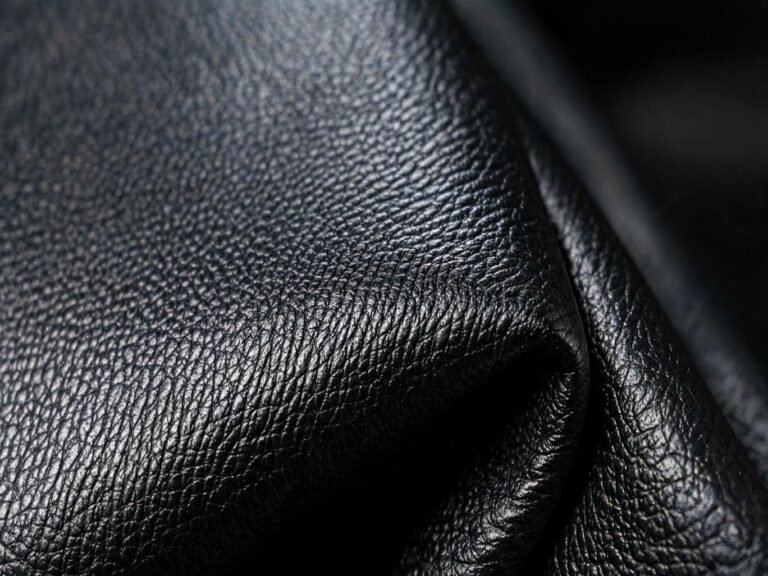
Macro view of black lychee-texture leather shows how surface pattern affects light reflection and perceived color depth.
UV Fading in Black Leather for Upholstery Applications
Black surfaces absorb more UV radiation than any other color — roughly 95% of incident light across the UV-A and UV-B spectrum. This energy breaks down organic dye molecules at the molecular level, causing the characteristic fade from black to gray-brown. Black leather upholstery UV fading prevention starts with understanding which test standards apply and what passing grades actually mean.
The relevant standards for color fastness testing include ISO 105-B02 (xenon arc, color fastness to artificial light), SAE J2412 (automotive interior material UV exposure), and ASTM G154 (standard practice for operating fluorescent UV apparatus). A grade 4 rating under ISO 105-B02 means “slight fading” is visible — acceptable for some applications but problematic for premium automotive interiors where customers expect zero perceptible change over 3-5 years.

Color fastness testing under xenon arc lamps simulates years of UV exposure in days, revealing which black leather formulations hold their depth.
In our laboratory, we run black leather samples to ISO 105-B02 grade 5 (no visible change) as the baseline acceptance criterion. Silicone leather achieves this grade consistently because its inorganic pigment system — iron oxide and carbon black particles suspended in the silicone matrix — resists photodegradation far better than the organic dyes used in conventional PU. We’ve documented silicone leather color fastness test results showing zero Delta E shift after 1,000 hours of xenon arc exposure, compared to Delta E values of 3.5-4.2 for standard PU at the same interval.
Technical note: Delta E (ΔE) is the industry metric for perceptible color difference. Values below 1.0 are imperceptible to the human eye. Values above 3.0 are clearly visible. For black upholstery in multi-unit installations, specify maximum ΔE of 1.5 between any two units in the same production batch.
Heat Absorption and Surface Temperature Management
Black leather upholstery heat resistance specification data directly impacts user comfort and material longevity. Under 1,000 W/m² solar irradiance (typical midday sun), black leather surface temperatures can reach 70-80°C — hot enough to cause low-temperature burns on contact and to accelerate polymer degradation in synthetic materials.
| Test Parameter | Conventional PU | Genuine Leather | Silicone Leather |
|---|---|---|---|
| UV hours to visible fade (ΔE > 3.0) | 150–250 hrs | 200–400 hrs | 1,000+ hrs |
| Surface temp at 1,000 W/m² (1 hr) | 78°C | 72°C | 69°C |
| Scratch visibility (cross-hatch, 2N load) | High (white stress marks) | Moderate (natural patina) | Low (self-healing surface) |
| Color matching tolerance (ΔE achievable) | ±2.0 | ±3.0 (hide variation) | ±0.8 |
The 9°C temperature difference between conventional PU and silicone leather may seem modest, but it matters at the threshold where touch temperature becomes uncomfortable. Automotive OEMs increasingly specify maximum surface temperature limits (typically 60-65°C for skin-contact surfaces) in response to ASTM G154 weathering data and consumer safety concerns.

Dark-toned leather surfaces require precise pigment formulation to maintain color consistency across folded and flat areas.
Scratch Resistance in Black Leather for Upholstery
Scratches are approximately three times more visible on black surfaces than on mid-tone colors. This isn’t subjective — it’s a function of contrast. A surface abrasion that removes the top coating exposes the lighter substrate underneath, creating a bright line against the black background. Black synthetic leather upholstery scratch resistance therefore depends not just on the coating hardness but on the substrate color match.
Silicone leather addresses this through a fundamentally different mechanism. Rather than relying on a hard top coat that scratches white, the silicone polymer’s elastic recovery allows minor surface deformations to self-heal at room temperature. Cross-hatch scratch testing at 2N load shows visible white stress lines on PU leather but no visible marking on silicone samples — the surface deforms and recovers without coating rupture. For high-traffic applications like automotive seats and hospitality furniture, this difference eliminates the gradual “whitening” effect that ages black upholstery prematurely.
See how black silicone leather performs in automotive interior applications, including UV stability and scratch resistance demonstrations.
Specifying Black Material for B2B Projects
For procurement teams, the specification checklist for black upholstery leather should go beyond color name and thickness. Here’s what a complete spec sheet includes:
- Color code and Delta E tolerance: Specify the exact black (e.g., Pantone Black 6 C) and maximum inter-unit ΔE of 1.5
- UV test data: ISO 105-B02 grade 5 minimum, with test duration specified (500 or 1,000 hours)
- Heat resistance: Maximum surface temperature at defined irradiance level
- Scratch test method and pass criteria: Cross-hatch at defined load, with visual grading
- Pigment system declaration: Inorganic vs organic pigments — affects UV stability
When learning how to match black leather upholstery color batches across suppliers, the most reliable approach is to request physical reference samples and establish a master standard. Digital color codes help, but they don’t account for surface texture effects on perceived color. A cleaning and maintenance guide should also accompany the spec — black surfaces show residue from improper cleaning products more readily than lighter colors.

Black leather dominates automotive interiors — making UV stability and color consistency critical for OEM-grade sourcing decisions.
Frequently Asked Questions
Why does black leather fade faster than lighter colors?
Black surfaces absorb approximately 95% of incident UV radiation, converting that energy into heat and chemical reactions at the pigment molecule level. Organic dyes used in conventional PU and aniline leather break down under this energy, losing their chromophore structure. Lighter colors reflect 60-80% of UV, reducing the energy available for degradation. Silicone leather sidesteps this issue by using inorganic pigments (carbon black, iron oxide) that don’t have breakable organic bonds.
Can silicone leather maintain jet black without additional UV coatings?
Yes. The silicone polymer itself is UV-transparent but inherently stable — the Si-O backbone doesn’t photodegrade like C-C bonds in PU. Combined with inorganic pigments that resist UV breakdown, silicone leather maintains its original black without the sacrificial UV-blocking top coats that conventional PU requires. Our test data shows zero ΔE shift after 1,000 hours of xenon arc exposure with no additional surface treatment.
Specifying Black That Stays Black
Black leather for upholstery carries unique performance demands that lighter colors don’t face — higher UV absorption, greater heat buildup, and amplified scratch visibility. The material chemistry you choose determines whether your black upholstery ages gracefully or generates warranty claims. By specifying testable parameters — UV hours to fade, surface temperature limits, scratch test grades, and Delta E tolerances — procurement teams can hold suppliers accountable to performance rather than appearance alone. Silicone leather’s inorganic pigment system and elastic surface recovery offer measurable advantages in every category that matters for black upholstery longevity.
Schedule Material Testing Consultation
About TOPSUN
TOPSUN engineers black leather for upholstery with UV-stable inorganic pigments for automotive, furniture, and hospitality clients requiring color consistency across multi-unit installations and extended service lifecycles.
ISO 105-B02 grade 5 color fastness · ΔE ±0.8 batch-to-batch consistency · 1,000+ hour xenon arc UV stability · Self-healing scratch-resistant surface technology