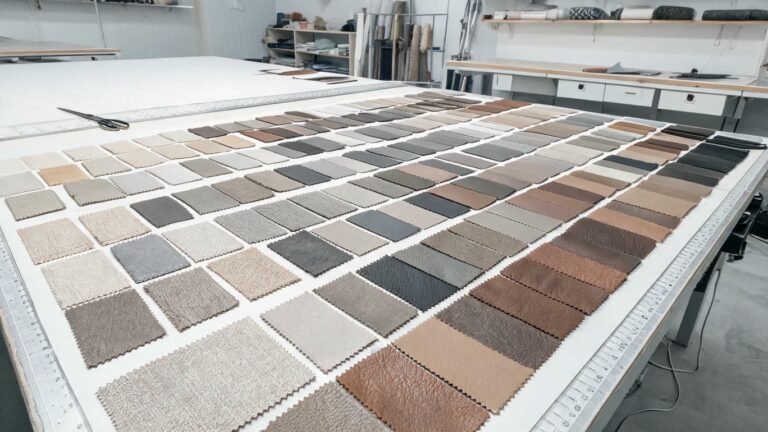
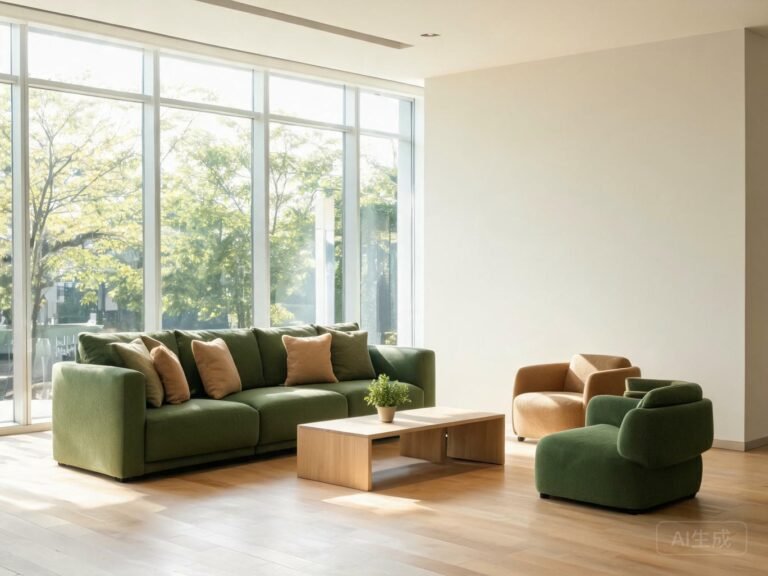
A furniture brand’s design team approves a fabric swatch in the showroom — buttery hand feel, perfect color match, elegant drape. Six months into production, customer complaints roll in: the sofa surface has pilled, armrest seams are fraying, and the once-luxurious texture now feels rough and cheap. The gap between showroom sample and production reality is where most furniture and fabric projects fail. Bridging that gap requires translating aesthetic approval into engineering specifications — Martindale ratings, hand feel tolerances, cutting yield targets, and roll-level quality control — before a single meter is purchased.
Request Furniture Fabric Samples
What Furniture and Fabric Specifications Actually Matter for Sofa Manufacturing
The specifications that matter in furniture and fabric production aren’t the ones that win design awards. They’re the ones that survive 10,000 hours of daily use without degradation. Designers evaluate fabric on aesthetics — color, texture, drape. Manufacturing teams need to evaluate fabric on engineering parameters: abrasion resistance, seam strength, dimensional stability, and coating adhesion. When these two evaluation frameworks don’t align, the result is a beautiful product that fails in the field.
Here’s what a production-ready furniture and fabric spec sheet should contain beyond color and texture. First, Martindale abrasion rating matched to the intended use case — residential, commercial, or hospitality. Second, seam slippage resistance (typically tested per EN ISO 13936-1), because the weakest point in any upholstered sofa is the seam, not the surface. Third, colorfastness to rubbing (dry and wet, per ISO 105-X12), which determines whether dark upholstery will stain light-colored clothing during the first six months of use. Fourth, coating adhesion for synthetic leathers, because delamination is the number one warranty claim in furniture upholstery. These four parameters, documented with third-party test reports, separate spec sheets that protect your production line from spec sheets that just look good in a catalog.

Production floor with multi-color leather rolls ready for furniture upholstery cutting
In our experience working with furniture and sofa applications, brands that skip the engineering spec stage and move straight from swatch approval to bulk ordering face a 20-30% defect rate in their first production run. The cost of a third-party test report — typically $500-1,500 for a full furniture fabric assessment — is negligible compared to the cost of recalling a production batch because the fabric failed at the seams during the first month of customer use.
Hand Feel Control: The Hidden Variable in Upholstery Quality
Hand feel is the most discussed yet least specified parameter in furniture fabric sourcing. Every buyer wants “soft but durable” — but softness is a measurable property, not a subjective impression. Without quantification, you’re trusting the supplier’s sample to represent 10,000 meters of production material. It won’t.
Professional hand feel evaluation uses three measurable axes: softness (bending length per BS 3356), surface friction coefficient (per ASTM D1894), and compression resilience (per ISO 24356). A fabric that scores high on softness but low on compression resilience will feel luxurious in the showroom and flatten to cardboard within six months of sofa use. A fabric with high surface friction may feel premium to the touch but will resist the sewing machine feed dogs, causing production line slowdowns and seam puckering. Any sofa fabric manufacturer guide worth its salt will provide these three values alongside the more commonly cited thickness and weight.

Hand feel evaluation — softness fold test showing drape and flexibility of furniture-grade leather
The production risk of ignoring hand feel consistency is invisible until it’s catastrophic. If a supplier delivers rolls with a softness variance of more than 15% across the batch, the finished sofa cushions will have visibly different drapes. Customers notice. One of our furniture brand clients rejected a 5,000-meter PU leather delivery because the hand feel shifted from “buttery” on roll one to “plasticky” on roll twelve — a 22% bending length variance that the supplier’s QC had never measured because their spec sheet listed only “soft hand feel” as a qualitative note.
Specification tip: Require your supplier to report hand feel as a numeric range (e.g., bending length 35-45mm), not a qualitative adjective. If they can’t provide the number, they’re not measuring it — and you’ll discover the variance on your production line, not in your quality lab.
Martindale Ratings Decoded: Matching Abrasion Resistance to Use Cases
The Martindale abrasion test (ISO 12947) is the furniture industry’s universal durability benchmark — but most buyers misuse it. They pick a single number (“we need 25,000 cycles”) without matching it to the actual furniture application. The result is either over-engineered fabric that inflates material cost by 30-50%, or under-specified fabric that fails within the warranty period.
The Martindale test measures how many abrasion cycles a fabric withstands before two yarns break (for woven fabrics) or the surface coating shows visible wear (for coated fabrics like synthetic leather). The test uses a figure-8 motion with wool abradant pads, which simulates the multi-directional friction that occurs when someone sits down, shifts position, and stands up repeatedly. It cannot be directly compared to the Wyzenbeek test, which uses a back-and-forth motion with cotton duck or wire mesh — a common confusion that leads to apples-to-oranges material comparisons. For more on silicone versus PU material comparison, the Martindale gap is dramatic.

Color fastness and abrasion testing equipment used for furniture fabric quality verification
The table below maps Martindale minimums to furniture applications — use it as a starting point, then adjust based on your specific warranty period and target market.
| Furniture Application | Martindale Minimum | Typical Material | Primary Risk Factor |
|---|---|---|---|
| Residential sofa (light use) | 15,000 cycles | PU leather, woven polyester | Color fading from sunlight |
| Residential sofa (heavy family use) | 25,000 cycles | PVC leather, microfiber | Seam fraying from daily use |
| Commercial office furniture | 50,000 cycles | Heavy PU, silicone leather | Coating delamination |
| Hospitality / hotel lobby | 75,000+ cycles | Silicone leather, genuine leather | Stain penetration in high traffic |
Note that silicone leather routinely tests at Martindale ≥100,000 cycles — well above the hospitality threshold. This doesn’t mean every sofa needs silicone leather. It means that for applications where replacement cost, downtime, and brand reputation matter more than per-meter material cost, the durability margin pays for itself. The ISO 12947 standard provides the testing methodology (ISO 12947-2:2016), but the application-specific threshold is your engineering decision.
Bulk Roll Purchasing: From Cutting Yield to Waste Reduction
The true cost of furniture fabric isn’t the per-meter price. It’s the per-meter price divided by cutting yield, plus the cost of waste from roll inconsistency. A supplier quoting $8/meter with 85% cutting yield is cheaper than one quoting $7/meter with 70% cutting yield — but most procurement teams never calculate this because the yield data isn’t on the quotation.
Cutting yield depends on three factors: roll width consistency, pattern repeat alignment, and defect distribution. Roll width variance of more than 1cm across a batch throws off nesting layouts and creates edge waste. Pattern repeats that don’t align across rolls make seamless sofa panel matching impossible. And concentrated defects — a 2-meter blemish zone in the middle of a 50-meter roll — destroy yield because the defective section must be cut out and discarded. When evaluating furniture fabric durability and sourcing options, ask suppliers for their historical yield data on similar projects.

Sofa manufacturing line showing furniture fabric cutting and upholstery application
Three bulk purchasing practices that reduce waste. First, specify roll width tolerance in your PO (±0.5cm is achievable for quality suppliers). Second, request end-to-end defect maps for each roll — a simple spreadsheet showing meter positions of any visible defects — so your cutting team can plan around them. Third, negotiate “usable meters” pricing instead of “total meters” pricing, where the supplier guarantees a minimum usable length per roll. These three clauses alone can improve your cutting yield by 8-12%, which on a 10,000-meter order translates to 800-1,200 meters of recovered material.
See how silicone leather performs in luxury furniture applications — hand feel, durability, and cleanability demonstrated
When to Upgrade from PU to Silicone Leather in Furniture and Fabric Applications
PU leather dominates the furniture and fabric market on price — $3-6 per meter versus silicone leather’s $12-20 per meter. But price-per-meter is the wrong metric for furniture that needs to survive commercial use. The right metric is cost per year of service life, and on that metric, silicone leather wins decisively in any application where the sofa stays in service for more than three years.
Here’s the math. A PU leather sofa in a hotel lobby typically needs reupholstery every 18-24 months due to surface cracking, coating delamination, and irreversible staining. Each reupholstery cycle costs $200-400 per sofa in labor and material, plus downtime. Over a 10-year period, that’s 5-6 replacement cycles. A silicone leather sofa — with Martindale ≥100,000 cycles, zero VOC emissions, and inherent stain resistance that allows wipe-clean maintenance — has a projected service life of 10+ years with zero reupholstery. The initial material premium is recovered within the first replacement cycle. For a deeper understanding of silicone leather introduction and its performance advantages, the key differentiators are hydrolysis resistance, UV stability, and the fact that the silicone coating doesn’t plasticize or embrittle over time.

Faux leather sofa upholstery — material upgrade considerations for commercial furniture applications
One of our hospitality clients switched from PU leather to silicone leather for a 200-unit hotel sofa project after their previous PU upholstery started cracking within 18 months of installation. The silicone leather upgrade added 15% to material cost but eliminated the replacement cycle entirely. The sofas are now in their fourth year with zero warranty claims related to surface degradation — a result that would have been impossible with PU at any price point.
Upgrade decision framework: Choose silicone leather when (1) the furniture will be in service 5+ years, (2) the application involves public or high-traffic use, (3) cleaning frequency is daily or weekly, or (4) VOC compliance and indoor air quality certifications are required. Choose PU leather for short-life-cycle residential products where cost per meter is the primary constraint.
Frequently Asked Questions
What Martindale rating do I need for a commercial sofa?
Commercial sofas in office environments require a minimum of 50,000 Martindale cycles. For hospitality applications (hotel lobbies, restaurant booths), specify 75,000 cycles or higher. Silicone leather, which routinely tests at ≥100,000 cycles, exceeds both thresholds and is particularly suited for hospitality furniture where replacement downtime directly impacts revenue.
How does hand feel affect furniture fabric cutting yield?
Hand feel directly affects cutting yield through two mechanisms. First, fabrics with high surface friction resist the cutting table’s vacuum hold-down system, causing material shift during automated cutting and creating edge waste. Second, inconsistent hand feel across rolls — a variance of more than 15% in bending length — forces operators to adjust cutting pressure mid-run, which increases miscuts. Specify bending length tolerance in your PO to control this variable.
From Spec Sheet to Production Floor: Your Furniture Fabric Roadmap
Furniture and fabric sourcing fails when aesthetic approval replaces engineering specification. The showroom swatch tells you what the fabric looks like. The Martindale rating, hand feel measurements, cutting yield data, and roll-level quality reports tell you whether it will survive production and service. Specify abrasion resistance matched to your use case. Quantify hand feel instead of describing it. Calculate true cost per usable meter, not per total meter. And when the application demands durability beyond what PU leather can deliver — commercial, hospitality, healthcare, or any furniture expected to last more than three years — upgrade to silicone leather and recover the premium within the first avoided replacement cycle. The furniture and fabric specification you write today determines whether your production line runs smoothly or becomes a warranty claim factory tomorrow.
Get a Custom Furniture Fabric Quote
About TOPSUN
TOPSUN engineers silicone leather for furniture and fabric applications where hand feel consistency and abrasion resistance determine product longevity across residential and commercial sofa production lines.
Martindale ≥100,000 cycles verified in-house testing lab, 500,000+ meter monthly capacity for bulk roll orders, custom Pantone matching with ±1.5ΔE color tolerance, and California Prop 65 compliant with zero formaldehyde emissions for North American furniture markets.