Laboratory environments place extraordinary demands on every material used within them. From routine chemical spills and constant sanitization cycles to strict cleanroom particulate requirements, the leather for lab furniture must deliver a combination of properties that ordinary upholstery materials simply cannot provide. Whether outfitting a pharmaceutical research facility, a university science lab, or a high-sensitivity cleanroom, choosing the right laboratory furniture material directly impacts safety, compliance, and long-term cost efficiency.
In this guide, we explore the critical performance requirements for lab upholstery, explain why silicone leather has become the material of choice for forward-thinking facilities, and provide a clear comparison against traditional options such as PU and PVC. All performance data referenced below is sourced from our in-house testing laboratory, which conducts rigorous assessments under internationally recognized standards including ASTM International protocols and ISO 14644 cleanroom specifications.

Key Performance Requirements for Lab Furniture Upholstery
When evaluating lab bench upholstery or seating materials for research environments, facility managers and procurement teams should prioritize four essential performance categories:
1. Chemical Resistance
Laboratory surfaces routinely encounter acids, alkalis, solvents, and disinfectants. Upholstery must withstand repeated exposure without cracking, discoloration, or degradation. TOPSUN silicone leather has been validated against common laboratory disinfectants including alcohol-based solutions, sodium hypochlorite (bleach), and quaternary ammonium compounds—maintaining its structural integrity and appearance even after hundreds of sanitization cycles.
2. Cleanability and Infection Control
Non-porous, fully waterproof surfaces are non-negotiable for healthcare-adjacent and biosafety laboratories. Silicone leather offers a completely sealed surface that resists staining and allows for rapid wipe-down decontamination. Our material achieves 99.9% antibacterial efficacy against Escherichia coli and Staphylococcus aureus, making it suitable for environments where cross-contamination prevention is critical.
3. Regulatory Compliance
Chemical resistant leather for laboratories must comply with multiple regulatory frameworks. TOPSUN silicone leather carries REACH and PAHs compliance, is certified zero-VOC and zero-formaldehyde, and contains no phthalates. For labs handling food-related research, our material also meets FDA food-grade certification and ISO 10993-5 biocompatibility standards.
4. Long-Term Durability
Lab furniture represents a significant capital investment. Upholstery that degrades prematurely leads to costly replacements and potential compliance failures. Our materials undergo accelerated aging at 85°C and 85% relative humidity per ASTM D3690, and salt spray exposure exceeding 1,000 hours under ASTM B117—both without measurable performance loss.
Why Silicone Leather Outperforms PU and PVC
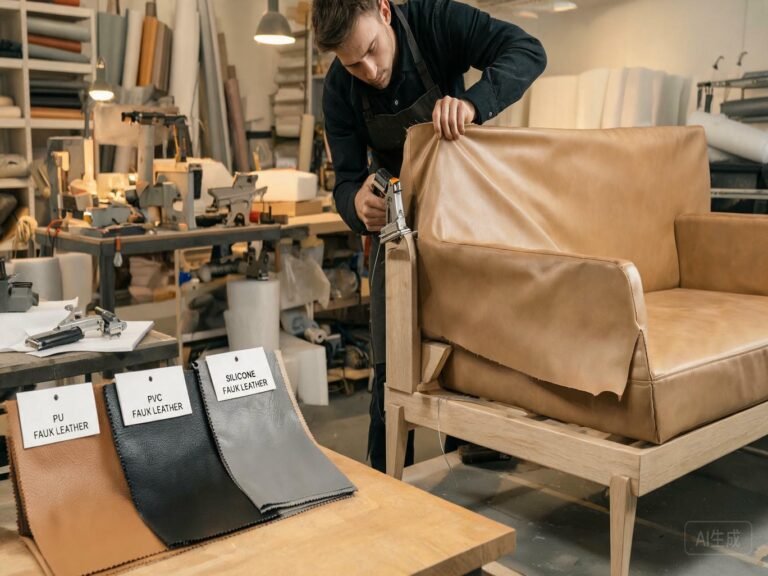
Traditional polyurethane (PU) and polyvinyl chloride (PVC) have been widely used in commercial furniture, but they exhibit well-documented shortcomings when subjected to the harsh conditions of laboratory use. PU materials are prone to hydrolysis in warm, humid environments—a common profile for many labs—leading to cracking and delamination. PVC raises concerns about plasticizer migration and chloride off-gassing, both of which are unacceptable in clean room leather applications.
Silicone leather, by contrast, is built on a silicone polymer backbone that is inherently resistant to hydrolysis, UV degradation, and thermal oxidation. It delivers consistently low particulate shedding and minimal chemical off-gassing, meeting the stringent requirements of ISO 14644 cleanroom classifications.
| Property | TOPSUN Silicone Leather | PU Leather | PVC Leather |
|---|---|---|---|
| Chemical Resistance | Excellent | Moderate | Moderate |
| Hydrolysis Resistance | Excellent | Poor | Good |
| Particulate Shedding | Very Low | Moderate | Low |
| VOC Emissions | Zero | Low–Moderate | Moderate |
| Phthalate-Free | Yes | Varies | No |
| Antibacterial (E. coli / S. aureus) | 99.9% | Not Standard | Not Standard |
| ASTM D3690 (85°C / 85% RH) | Pass | Fail (cracking) | Marginal |
| Cleanroom Suitable | Yes (ISO 14644) | No | Limited |
Application Scenarios
Cleanroom Seating and Work Surfaces
In controlled environments governed by ISO 14644, material selection directly impacts particulate counts and air quality. Clean room leather from TOPSUN demonstrates exceptionally low particle generation and minimal volatile organic compound (VOC) off-gassing, ensuring that upholstered seating, bench covers, and armrests do not compromise cleanroom integrity. This makes our silicone leather ideal for semiconductor fabrication labs, pharmaceutical production areas, and biotechnology research suites.

Lab Bench and Inspection Station Upholstery
Testing and inspection benches in research facility furniture setups require surfaces that can endure continuous chemical contact while maintaining a professional appearance. Silicone leather’s resistance to alcohol, bleach, and quaternary ammonium disinfectants ensures that routine decontamination protocols do not degrade the material. The non-porous surface prevents chemical absorption, eliminating the risk of cross-contamination between test batches.
Science Lab Seating
Ergonomic seating is essential for researchers who spend long hours at the bench. Science lab seating upholstered with silicone leather provides the comfort and tactile quality users expect, while the material’s durability ensures that chairs and stools maintain their appearance and structural integrity over years of heavy use. The waterproof, stain-resistant surface also simplifies maintenance—a practical advantage in busy teaching and research labs.

Request a Material Sample for Your Lab Project
Evaluate TOPSUN silicone leather firsthand. We provide free sample swatches with technical data sheets tailored to laboratory and cleanroom applications.
See It in Action: Performance Testing
Our in-house testing laboratory conducts comprehensive evaluations of every material batch, including abrasion resistance, scratch resistance, accelerated aging, and chemical exposure. Watch the video below to see how TOPSUN silicone leather performs under rigorous testing conditions.
For a detailed breakdown of our testing methodologies, including ASTM D3690 accelerated aging and ASTM B117 salt spray results, refer to our comprehensive leather durability testing guide.

Frequently Asked Questions
Can silicone leather be used in ISO Class 5 (Class 100) cleanrooms?
Yes. TOPSUN silicone leather has been validated for use in controlled environments. Its low particulate shedding and zero VOC emissions meet the requirements of ISO 14644 for cleanroom-compatible materials. We recommend specifying the smooth-surface variant for the most stringent classifications.
How does silicone leather compare to real leather in a lab setting?
While genuine leather offers aesthetic appeal, it is highly porous, absorbs chemicals, cannot withstand repeated disinfection with harsh agents, and sheds particulates—making it unsuitable for most laboratory applications. Silicone leather provides a similar premium feel while delivering the chemical resistance, waterproof properties, and cleanroom compatibility that laboratory environments demand.
What disinfectants are compatible with TOPSUN silicone leather?
Our material is compatible with isopropyl alcohol (up to 70%), sodium hypochlorite (diluted bleach), quaternary ammonium compounds, and most common laboratory-grade disinfectants. Prolonged exposure to concentrated strong acids or strong bases should be evaluated on a case-by-case basis—contact our technical team for specific compatibility guidance.
Does TOPSUN offer custom colors and thicknesses for lab furniture?
Yes. We offer an extensive range of colors, surface textures, and thickness options (0.6mm–2.0mm) to meet diverse design and performance requirements. Custom color matching is available for large-volume orders. Request our full sample kit to explore the options available for your research facility furniture project.
Is silicone leather suitable for food testing laboratories?
Absolutely. TOPSUN silicone leather holds FDA food-grade certification and ISO 10993-5 biocompatibility accreditation, making it appropriate for food science laboratories, quality control testing facilities, and any environment where food contact is possible. Combined with its fully waterproof and stain-resistant surface, it is an ideal choice for food-related research applications.
Upgrade Your Lab Furniture with Proven Performance
Partner with TOPSUN for lab-grade silicone leather backed by in-house testing, international certifications, and dedicated technical support.
Related Resources
- Medical & Healthcare Applications — Discover how our materials serve healthcare and cleanroom environments.
- Medical-Grade Silicone Leather Upholstery — Deep dive into medical-grade material properties.
- Leather Durability Testing Guide — Complete reference for ASTM and ISO testing standards.
- Hydrolysis-Resistant Silicone Leather — Why hydrolysis resistance matters in humid lab conditions.